
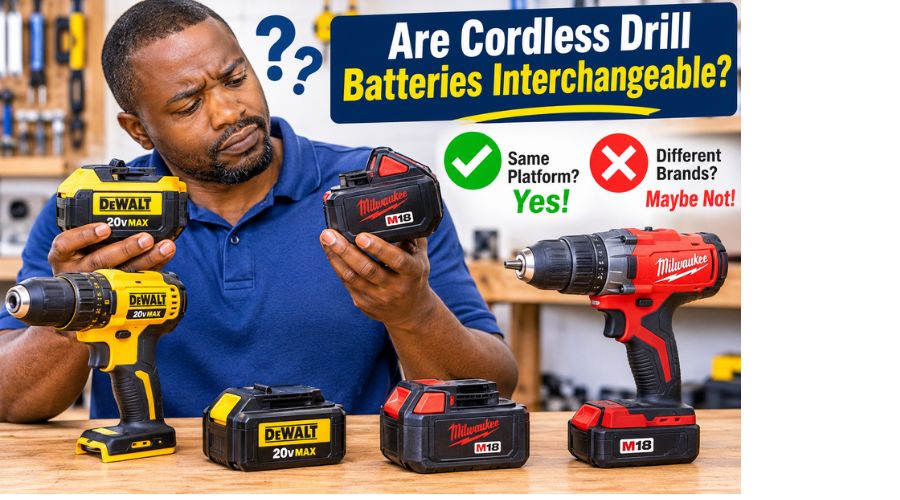
Investing in a cordless drill is a great choice if you want freedom to work without being tied to a power cord. However, like any rechargeable power tool, a cordless drill depends on its battery to keep you working. If you’re a garage warrior like me, you’ve probably experienced the frustration of a cordless battery dying in the middle of an important project.
When this happens, one of the first questions is, “Are cordless drill batteries interchangeable?”
Before using a spare battery from another drill, understand how battery compatibility works. Using the wrong battery can prevent your drill from operating, damage its electrical components, or create a safety hazard.
The short answer is that some cordless drill batteries are interchangeable, but not all batteries are compatible with every drill. Compatibility depends on the manufacturer, battery platform, voltage, physical design, and electrical specifications.
Batteries from the same manufacturer may work across several drills and other power tools if they belong to the same battery platform. However, batteries from different brands are generally not interchangeable without a compatible adapter or a manufacturer-approved solution.
In this guide, we’ll explain how cordless drill battery compatibility works, why batteries from different brands often cannot be swapped, and how to choose the right replacement battery for your drill.
Also Read:
Can a cordless drill be used as a screwdriver?
Are Cordless Drill Batteries Interchangeable?
Yes, cordless drill batteries can be interchangeable, but only when they are designed to work together.
For example, a battery from one cordless drill may fit another drill from the same manufacturer if both tools use the same battery platform. This is particularly common among manufacturers that offer multiple power tools powered by a shared battery system.
However, two batteries can have the same voltage and still be incompatible.
For example, a 20V battery from one manufacturer may not fit a 20V drill from another manufacturer because the battery packs may have different shapes, terminals, locking mechanisms, and electronic communication systems.
Even batteries from the same brand may not be compatible if they belong to different product generations or battery platforms.
Before replacing your cordless drill battery, check the following:
- The manufacturer and battery platform.
- The voltage rating of the battery and drill.
- The physical design and terminal arrangement.
- The battery’s compatibility with your specific drill model.
- Any electronic communication or protection requirements.
The safest option is to use a replacement battery recommended by the drill manufacturer.
Why Are Cordless Drill Batteries from Different Brands Not Interchangeable?
One of the most common questions among cordless tool owners is why manufacturers don’t make batteries interchangeable across different brands.
After all, if two drills operate at the same voltage, shouldn’t their batteries be compatible?
Unfortunately, it’s not that simple. Several technical and commercial factors influence battery compatibility.
Different Battery Designs and Connectors
Every cordless tool manufacturer develops battery packs with specific physical dimensions, connectors, and locking mechanisms.
These designs ensure the battery fits securely in the tool and delivers power through the correct terminals.
For instance, one brand may use a slide-on mounting system, while another uses a different arrangement of rails and locking tabs.
Even if both batteries have the same voltage, their physical designs may prevent them from fitting into the same drill.
The electrical terminals may also be positioned differently, making it impossible to establish a proper connection without modifying the battery or tool.
This is one reason why batteries from different manufacturers are generally not interchangeable.
Different Electrical Specifications
Battery compatibility also depends on the battery pack’s electrical characteristics.
Two batteries may have similar voltage ratings but differ in their maximum current output, internal resistance, and protection systems.
A cordless drill needs a battery that can supply enough current to run its motor safely.
If the battery cannot offer the required current, the drill may perform poorly, overheat, or shut down unexpectedly.
Some battery packs also include electronic systems that communicate with the tool to monitor temperature, current, and battery condition.
If the drill and battery cannot communicate correctly, the tool may refuse to operate or may not receive the protection it needs.
Battery Compatibility and Manufacturer Business Strategies
Manufacturers also use proprietary battery systems for commercial reasons.
When customers purchase a cordless drill, they usually invest in the manufacturer’s battery platform.
If they later purchase another tool from the same brand, they may be able to use their existing batteries and chargers.
This encourages customers to remain within the same product ecosystem.
However, manufacturers also design battery platforms to distinguish their products from competitors’ offerings.
Although commercial considerations can influence battery compatibility, technical requirements and safety standards also matter.
How Do Cordless Drill Battery Platforms Work?
A cordless drill battery platform is a system that allows compatible batteries to power multiple tools from the same manufacturer.
For example, a manufacturer may provide drills, impact drivers, circular saws, and work lights that use the same battery family.
Instead of purchasing a separate battery for every tool, you can use one compatible battery across several products.
This arrangement is convenient and can reduce the cost of expanding your cordless tool collection.
However, battery platforms aren’t always universal across every tool a manufacturer makes.
A company may offer several battery systems for different voltage levels, tool sizes, or equipment generations.
Before buying a replacement battery, identify the exact battery platform your drill uses.
Can You Use a Battery From Another Tool of the Same Brand?
Yes, as long as both tools use the same compatible battery platform.
For example, if your cordless drill and impact driver use the same 18V battery system, their batteries may be interchangeable.
However, don’t assume every battery from the same manufacturer will work with every tool.
Some manufacturers provide multiple battery platforms, including compact systems for light-duty tools and higher-voltage systems for demanding applications.
The safest approach is to check the manufacturer’s compatibility chart or the product manual.
Does Battery Voltage Matter When Interchanging Cordless Drill Batteries?
Yes. Voltage is one of the most important factors to consider when choosing a replacement cordless drill battery.
The voltage rating indicates the electrical potential the battery pack supplies. Generally, higher-voltage cordless drills are designed for more demanding applications.
For example, an 18V drill may suit general household repairs, furniture assembly and moderate drilling tasks.
A higher-voltage drill may provide greater power for heavy-duty drilling, large fasteners, or demanding construction work.
However, voltage alone does not determine whether a battery is compatible with a drill.
Can You Use a 20V Battery on an 18V Drill?
Yes. Many cordless tool manufacturers use the same nominal battery platform while advertising different voltage ratings.
For example, certain batteries marketed as 20V maximum are rated at 18V nominal.
These batteries may be compatible with tools advertised as 18V, as long as they belong to the same battery platform.
The important distinction is that nominal voltage and maximum voltage are not always the same.
A fully charged lithium-ion battery can produce a higher voltage than its nominal rating.
So don’t assume every 20V battery can safely power every 18V drill.
Always check the manufacturer’s compatibility information.
Can You Use a Higher-Voltage Battery on a Lower-Voltage Drill?
Do not use a higher-voltage battery unless the manufacturer specifically confirms it is compatible with your drill.
Connecting a battery with a voltage higher than the tool is designed to handle can damage the motor, electronic controls, or other internal components.
It may also create excessive heat and increase the risk of electrical failure.
A battery that physically fits into a drill is not necessarily electrically compatible.
Can You Use a Lower-Voltage Battery on a Higher-Voltage Drill?
A lower-voltage battery may fit into a compatible battery platform but still fail to provide the required power.
The drill may operate poorly, stop unexpectedly, or refuse to start.
In some cases, the battery’s protection system may prevent the tool from operating.
Always use a battery with the voltage rating recommended for your drill.
Are Lithium-Ion Cordless Drill Batteries Interchangeable?
Lithium-ion batteries are among the most common power sources for modern cordless drills.
They are popular because they offer a good balance of power, weight, and energy storage.
However, just because two batteries use lithium-ion technology doesn’t mean they are interchangeable.
Battery chemistry is only one part of compatibility.
Two lithium-ion batteries may have different voltage ratings, cell configurations, connectors, and electronic protection systems.
For example, a lithium-ion battery designed for a compact 12V drill may not be compatible with a larger 18V or 20V drill.
Even batteries from the same manufacturer may use different lithium-ion cell arrangements.
When replacing a lithium-ion drill battery, check the model number, voltage, battery platform, and manufacturer’s compatibility information.
What Does Amp-Hour Rating Mean on a Cordless Drill Battery?
Amp-hours (Ah) indicate how much electrical charge a battery can store.
A battery with a higher amp-hour rating generally provides longer runtime than a compatible battery with a lower rating.
For example, a 4.0Ah battery will typically run a cordless drill longer than a 2.0Ah battery under similar working conditions.
However, actual runtime depends on several factors, including the type of material being drilled, the drill’s power requirements, and the battery’s condition.
Can You Use a Higher-Amp-Hour Battery on Your Drill?
Yes, as long as the battery is compatible with your drill’s battery platform and voltage requirements.
A higher-capacity battery can provide longer runtime without necessarily damaging the drill.
For example, if your drill is designed for a particular 18V battery platform, a compatible 5.0Ah battery may offer longer working time than a 2.0Ah battery.
However, larger batteries are often heavier and may make the drill less comfortable for extended overhead work.
Choose a battery capacity that suits your projects and working conditions.
Can You Use a Different Brand’s Battery With an Adapter?
Yes, battery adapters are available for some cordless tool platforms.
These adapters allow certain batteries to connect to tools from another manufacturer.
However, they do not make every battery and drill combination compatible.
A battery adapter primarily addresses the physical connection between the battery and the tool. It may not provide the electronic communication or protection systems the drill requires.
Before using an adapter, confirm that it supports the specific battery and tool models you intend to connect.
Also, remember that using a third-party adapter may affect your tool’s warranty.
Are Battery Adapters Safe?
Battery adapters can be useful when properly designed and used with compatible tools.
However, an unsuitable adapter may create electrical or mechanical problems.
Potential risks include:
- Incorrect voltage delivery.
- Poor electrical connections.
- Excessive current draw.
- Overheating.
- Loss of battery protection features.
Avoid modifying battery terminals or cutting away plastic components to force a battery into a drill.
If you need to use an adapter, choose one from a reputable manufacturer and verify its compatibility with your equipment.
How to Check Whether Your Cordless Drill Battery Is Compatible
Before purchasing a replacement battery, take a few minutes to verify compatibility.
This can help you avoid wasting money on a battery that doesn’t fit or work correctly.
Check the Drill’s Model Number
The model number is usually printed on the drill’s body, battery compartment, or product label.
Use this information to find the manufacturer’s specifications and recommended battery models.
Identify the Battery Platform
Check the battery pack for its model number and voltage rating.
Some manufacturers print the battery platform name directly on the pack.
If you cannot identify the platform, consult the owner’s manual or manufacturer’s website.
Compare the Voltage Ratings
Make sure the replacement battery matches your drill’s voltage.
Don’t rely on physical fit alone.
Check the Battery’s Physical Design
Compare the mounting rails, terminals, and locking mechanism.
The battery should fit securely without forcing it.
Confirm Compatibility With the Manufacturer
If youare unsure, contact the manufacturer or check its official battery compatibility chart.
This is especially important when purchasing batteries from third-party manufacturers.
Reasons for Going Cordless
Battery compatibility may make you hesitate before buying a cordless drill.
However, cordless drills offer several advantages that make them an excellent choice for homeowners, DIY enthusiasts, and professionals.
Greater Mobility
One of the biggest advantages of a cordless drill is that you can use it without being connected to a power outlet.
This makes it easier to work in garages, gardens, construction sites, and other locations where electricity may not be readily available.
Improved Convenience
Cordless drills eliminate the need to manage extension cords while working.
This makes them convenient for drilling holes, assembling furniture, and completing household repairs.
Easy Storage
Cordless drills are generally compact and easy to store.
Many models come with carrying cases that let you keep the drill, batteries, and accessories organized in one place.
Better Portability
Modern cordless drills are designed for portability.
You can easily carry them between work locations without worrying about finding a power outlet.
Improved Battery Technology
Modern lithium-ion batteries provide better performance and longer runtime than many older battery technologies.
This makes cordless drills suitable for a wide range of applications.
Helpful Ways to Extend the Life of Your Cordless Drill Battery
Although cordless drill batteries eventually wear out, proper maintenance can help extend their useful life.
Here are some practical tips for keeping your battery in good condition.
Avoid Excessive Heat
Heat is one of the biggest factors that can shorten a lithium-ion battery’s life.
Avoid leaving your battery in direct sunlight or inside a hot vehicle for extended periods.
If the battery gets hot during heavy use, let it cool before charging.
Use the Correct Charger
Always use a charger approved for your battery platform.
Using an incompatible charger can damage the battery or create a safety hazard.
Avoid Deep Discharging
Modern lithium-ion batteries do not need to be completely drained before charging.
In fact, repeatedly running the battery until the drill stops can put unnecessary stress on the battery cells.
Recharge the battery when its charge becomes low.
Store Batteries Properly
If you will not be using your drill for an extended period, store the battery in a cool, dry place.
Avoid storing it in extremely hot or cold environments.
For long-term storage, follow the manufacturer’s recommendations for the appropriate charge level.
Keep Battery Contacts Clean
Dust and debris can accumulate around the battery terminals.
Use a clean, dry cloth to remove dirt and maintain good electrical contact.
Avoid using water or conductive materials to clean the terminals.
Use the Right Drill Settings
Using the correct drill speed and torque setting can help prevent unnecessary strain on the battery.
For example, drilling through hard materials may require more power than drilling through softwood.
Avoid forcing the drill to operate beyond its intended capacity.
When Should You Replace Your Cordless Drill Battery?
Like any rechargeable battery, a cordless drill battery eventually loses its ability to hold a charge.
The rate of deterioration depends on factors such as battery chemistry, usage patterns, storage conditions, and charging habits.
Here are some signs that your battery may need replacement.
Reduced Runtime
If your drill used to run for several hours but now loses power quickly, the battery may have lost capacity.
This is especially noticeable during demanding tasks.
Frequent Charging
A battery that needs to be charged more frequently than usual may be nearing the end of its useful life.
Unexpected Shutdowns
If the drill suddenly stops operating even though the battery appears to have charge remaining, the battery may be deteriorating.
However, the problem could also be caused by a faulty drill or charger.
Physical Damage
A battery that is cracked, swollen, leaking, or unusually hot should not be used.
Damaged lithium-ion batteries can pose a fire risk.
Stop using the battery and follow the manufacturer’s instructions for safe disposal or recycling.
Charging Problems
If the battery no longer charges properly, inspect the charger and battery contacts before assuming that the battery has failed.
A faulty charger or dirty terminal may also cause charging problems.
How to Change a Cordless Drill Battery
Replacing a cordless drill battery is usually straightforward. However, always follow the manufacturer’s instructions to avoid damaging the drill or battery.
Step 1: Turn Off the Drill
Switch off the drill and release the trigger before handling the battery. If the drill has a forward/reverse selector, place it in the center or locked position when available.
Remove any drill bit or accessory that could catch on clothing or cause injury. Set the drill on a stable surface so it cannot roll or fall while you work.
If the battery or drill feels unusually hot after use, allow it to cool before removing the battery.
Step 2: Remove the Existing Battery
Locate the battery release button or latch, usually on the battery pack or near the handle. Press or hold the release while sliding the battery away from the drill. Keep a firm grip on both the drill and battery so neither drops.
The pack should come free without excessive force. If it does not release easily, check the manufacturer’s instructions and make sure you are pressing the correct latch. Avoid prying the battery loose with tools, which could damage the housing or contacts.
Step 3: Check the Replacement Battery
Before installing the new battery, confirm that it is designed for your drill and battery platform. Check the required voltage and ensure the pack’s shape and connector match the tool.
A battery that fits physically may still be incompatible, so don’t rely on appearance alone. Inspect the replacement for cracks, swelling, leaks, or damaged contacts.
Do not use a battery that appears damaged. If you are unsure whether the battery is compatible, check the drill’s manual or the manufacturer’s compatibility information before proceeding.
Step 4: Insert the Replacement Battery
Hold the replacement battery with its contacts aligned to the matching rails or slots on the drill. Slide it into the battery compartment in the direction indicated by the tool’s design.
Apply steady pressure until the pack locks into place. You should hear or feel the latch engage, and the battery should sit securely without wobbling.
Do not force it if the rails or contacts do not line up. Remove the pack and check its orientation and compatibility instead. A secure connection helps the drill receive power reliably during use.
Step 5: Test the Drill
Once the battery is installed, hold the drill securely and briefly press the trigger to check that it starts and runs normally. Keep the bit area clear of hands, clothing, and loose objects. If the drill has speed settings or a direction selector, check that they respond as expected.
If the drill does not start, release the trigger, remove the battery, and recheck compatibility, battery charge, and visible contacts. Do not continue using a damaged or unusually hot battery.
Consult the manufacturer’s troubleshooting guidance if the drill still fails to operate.
How to Choose the Best Cordless Drill Battery
Choosing the right replacement battery involves more than comparing voltage and price. The battery’s capacity, chemistry, compatibility, and quality all affect how well your cordless drill performs.
Battery Voltage
Choose a battery with the voltage rating recommended for your drill. Voltage indicates the electrical potential supplied to the motor, so using the wrong rating may cause poor performance or damage.
Many cordless drill batteries are designed for a specific voltage platform, such as 12V, 18V, or 20V MAX. The “20V MAX” label commonly refers to the battery’s maximum voltage, while its nominal rating may be lower.
Check the drill’s label or manual before buying a replacement. A battery with a higher voltage is not automatically an upgrade if the drill is not designed to use it.
Amp-Hour Capacity
Amp-hour (Ah) capacity indicates how much energy a battery can store. Within the same compatible battery platform, a higher Ah rating generally provides longer runtime between charges. This can help with extended drilling or driving tasks, especially when working away from a charger.
However, higher-capacity batteries are often larger and heavier, which can make a cordless drill less comfortable to use overhead or in tight spaces.
Consider how long you typically work and whether you value runtime or a lighter tool. Also compare the battery’s price and charging time, since a larger pack may take longer to recharge.
Battery Chemistry
Lithium-ion batteries are widely used in modern cordless drills because they offer high energy density and relatively low weight. They also tend to hold their charge well when stored compared with older battery technologies.
Still, battery chemistry is only one part of performance: the pack’s design, protection circuitry, and compatibility with the drill matter too. Follow the manufacturer’s charging and storage instructions, and use a charger approved for the battery.
Avoid using a pack that is swollen, cracked, leaking, or unusually hot. Choosing a suitable lithium-ion battery can balance runtime, weight, and convenience for everyday drilling tasks.
Manufacturer Compatibility
Choose a replacement battery approved for your drill’s battery platform. Batteries may look similar but have different connectors, communication systems, or protection features. A pack that doesn’t fit correctly or isn’t recognized by the tool may not operate safely.
Check the drill’s model number and the battery compatibility list before purchasing. If you are considering a third-party replacement, verify that it explicitly supports your exact drill and charger.
Do not modify the battery or tool to make an incompatible pack fit. Confirming compatibility helps protect both the cordless drill and the replacement battery.
Battery Quality
Consider the battery manufacturer’s reputation, warranty, and built-in safety features. A quality battery should include appropriate protection against problems such as overcharging, overheating, and short circuits.
Read the product specifications carefully and check whether the seller provides clear information about capacity, compatibility, and warranty coverage. Be cautious of unusually cheap batteries with vague specifications or exaggerated runtime claims.
Purchase from a reliable seller and inspect the battery when it arrives. If the pack appears damaged or its labeling doesn’t match the advertised product, don’t use it. A dependable replacement battery can offer better peace of mind and value over time.
The video below illustrates how to use any battery with any power tool.
How to use any battery with any power tool
Frequently Asked Questions-FAQs
Are cordless drill batteries interchangeable between brands?
Generally, no. Different manufacturers use different battery designs, connectors, and electronic protection systems. Some third-party adapters may allow certain combinations, but compatibility should always be confirmed.
Can I use an 18V battery in a 20V drill?
Sometimes. Certain 18V and 20V batteries belong to the same battery platform and use different voltage descriptions for the same nominal battery system. However, compatibility depends on the manufacturer and specific models.
Can I use a 5.0Ah battery instead of a 2.0Ah battery?
Yes, if both batteries belong to the same compatible battery platform and have the correct voltage. The 5.0Ah battery will generally provide longer runtime but may be heavier.
Are cordless drill chargers interchangeable?
Some chargers work with several batteries from the same manufacturer, but not all chargers are compatible with every battery platform.
Always check the charger’s specifications before using it with a different battery.
Can cordless drill batteries expire?
Yes. Rechargeable batteries gradually lose capacity as they age and are used.
Proper storage and charging practices can help extend their useful life, but no battery lasts forever.
Is it safe to leave a drill battery plugged in all the time?
Most modern chargers are designed to stop charging when the battery reaches full capacity.
However, it is best to follow the manufacturer’s instructions rather than leaving the battery connected indefinitely.
Can I repair a cordless drill battery myself?
Battery repair is possible, but it can be dangerous.
Lithium-ion battery packs contain cells and electronic protection systems that can be damaged if handled incorrectly.
Unless you have the necessary training and equipment, replacing a faulty battery is generally safer than attempting to repair it.
How long does a cordless drill battery last?
Battery runtime depends on its capacity, the drill’s power requirements, and the type of work being performed.
A battery’s overall lifespan also depends on usage, storage, and charging conditions.
Why does my cordless drill battery not fit another drill?
The drills may use different battery platforms, mounting systems, or connector designs.
Even batteries from the same manufacturer may be incompatible if they belong to different product generations.
Conclusion
So, are cordless drill batteries interchangeable?
The answer is yes, but only when the batteries and tools are designed to work together.
Batteries from the same manufacturer may be interchangeable across multiple drills and other power tools, as long as they belong to the same compatible battery platform.
However, batteries from different brands are generally not interchangeable because of differences in voltage, connectors, physical design, and electronic protection systems.
Before replacing your cordless drill battery, always check its voltage, model number, battery platform, and compatibility with your drill.
Using the correct battery will help protect your investment, improve performance, and ensure that your cordless drill remains reliable throughout your projects.
If youare buying a new cordless drill, consider a battery platform that supports several tools. This can save you money and make it easier to expand your cordless power tool collection in the future.