
Cordless blinds make controlling natural light and privacy easier without the hanging lift cords found on traditional window blinds. You can usually raise or lower them by holding the bottom rail and moving it in the direction you want.
However, like other window coverings, cordless blinds can develop problems over time. You may find that the blinds refuse to stay up, become difficult to lower, hang unevenly, or stop moving smoothly. These problems can make an otherwise convenient window treatment frustrating to use.
Before replacing your blinds or buying new components, it is worth learning how to reset cordless blinds. In many cases, the problem stems from lost spring tension, uneven lifting, or a minor obstruction rather than a completely failed mechanism.
A careful reset may restore normal movement and save you the cost of unnecessary repairs. The exact procedure depends on the blind’s design and manufacturer, so identify the mechanism and follow the right instructions rather than forcing the bottom rail.
One important distinction before the steps: manual cordless blinds and motorized cordless shades use different reset procedures. The methods below focus mainly on manually operated blinds with spring-assisted lift systems.
Motorized shades may require a separate remote, battery, or electronic calibration reset. Also, a reset can restore tension or alignment, but it cannot repair a broken spring, damaged lift cord, or failed motor.
Also Read:
Understanding Cordless Blind Mechanisms
How Cordless Blinds Work
Cordless blinds operate without an exposed pull cord. Instead, you control the window covering by holding its bottom rail and moving it up or down.
Inside the headrail, a concealed lifting mechanism controls the movement and helps keep the blinds at the selected height.
The exact mechanism varies by product. Some use a spring-loaded system, while others use a tension-assisted arrangement with internal cords, pulleys, or a spring motor.
Cellular shades, faux wood blinds, aluminum mini blinds, and cordless roller shades can therefore behave differently even though they all have cordless operation.
Spring-loaded systems
A spring-loaded cordless blind uses stored mechanical energy to help lift and hold the blind. When you lower the blind, the internal spring mechanism stores or adjusts tension. When you raise it, that stored energy helps the blind move upward.
The mechanism is designed to balance the blind’s weight. If the tension becomes uneven, the blind may stop halfway, drift downward, or become difficult to raise. In some models, moving the blind through its full range of travel can reactivate or rebalance the mechanism.
Tension-based lift mechanisms
Some cordless window coverings use an internal tension system that works with cords or lift components hidden inside the headrail. These components help distribute the lifting force across the width of the blind.
When you operate the blind from one side instead of the center, the internal cords may become uneven or twisted. This can cause one end of the bottom rail to rise higher than the other. Operating the blind evenly and following the manufacturer’s recommended reset procedure can sometimes correct the problem.
Remember that not every cordless blind has an adjustable tension screw or a user-serviceable spring. Do not open the headrail or turn an internal adjustment wheel unless the product instructions specifically tell you to do so.
Common Problems That Require a Reset
A reset is worth trying when your cordless blinds show signs of a minor operating problem. Before attempting one, identify what the blinds are doing. This helps you choose the right approach and avoid making a mechanical fault worse.
Blinds won’t stay up.
One of the most common complaints is that cordless blinds won’t stay up after you raise them. You lift the bottom rail to the desired height, release it, and the blind slowly slides back down.
This can happen when the internal spring or tension mechanism is no longer holding the blind correctly. It may also occur after the blinds have remained fully lowered for a long time. In some designs, operating the blind through its full range can reactivate the lift mechanism.
If the blind keeps falling after several careful attempts, the spring, clutch, or another internal component may be worn or damaged.
Blinds won’t lower properly.
Another problem occurs when cordless blinds won’t go down even when you pull the bottom rail gently. The blind may move a short distance and stop, or it may feel as though something is holding it in place.
Possible causes include a twisted internal lift cord, an obstruction in the headrail, a jammed spring mechanism, or mounting brackets pressing against the operating components.
Before attempting a reset, check that the blind is seated correctly in its brackets and that nothing is blocking its movement. Do not pull harder to force it down. Excessive force can damage the internal cords or spring assembly.
Uneven or crooked blinds
If one side of the bottom rail sits higher than the other, the blind may have uneven tension or an internal cord that is not moving freely. This is particularly noticeable when the blind is fully lowered or raised.
The problem can sometimes develop when you operate the blind by pulling one corner rather than moving the bottom rail evenly. Some manufacturers specifically recommend lifting and lowering from the center or holding both ends evenly.
A careful full-range operation may help restore alignment. However, if the blind remains crooked, inspect the mounting brackets and look for signs of damaged internal components.
Stuck or sluggish movement
Cordless blinds should move smoothly when you raise or lower them. If the bottom rail feels unusually heavy, jerks during operation, or stops unexpectedly, the mechanism may need attention.
Dust and debris around the headrail or mounting brackets can interfere with movement. Incorrectly positioned brackets can also pinch the headrail and affect the internal lift components.
A gentle inspection and cleaning may resolve a minor obstruction. If the mechanism still feels stiff, stop operating it and consult the manufacturer’s troubleshooting instructions.
Tools and Preparation
Before resetting cordless blinds, prepare the area and identify your window covering type. A little preparation can prevent accidental damage and make the process easier.
What You’ll Need
You generally do not need specialized tools to perform a basic cordless blind tension reset. Most manual resets involve operating the bottom rail carefully to restore the mechanism’s movement.
However, the following items can be useful.
1. Stable Step Ladder (If Necessary)
If your blinds are installed on a high window, you may need a step ladder to reach the bottom rail comfortably. Choose a stable ladder that allows you to work without stretching or standing on the top step.
Position it on a level surface and make sure you can reach the blind without leaning sideways. If the window is particularly high or difficult to access, consider getting assistance rather than attempting the repair from an unstable position.
2. Clean Workspace
Clear the area beneath the window before you begin. Move furniture, decorative items, and other objects that could interfere as the blind moves.
A clear workspace gives you enough room to lower the blinds fully and inspect their movement. It also reduces the risk of knocking something over while handling the bottom rail.
3. Soft Cloth for Cleaning Debris
A clean microfiber cloth or another soft, lint-free cloth can help remove dust from the bottom rail, headrail, and accessible areas around the brackets.
Dust buildup may not be the main reason a blind has lost tension, but cleaning can help eliminate simple obstructions. Avoid soaking the mechanism or spraying cleaning chemicals directly into the headrail.
4. Manufacturer’s Instructions
If possible, locate the installation manual or identify the blind’s brand and model. This is particularly important for cellular shades, roller shades, and specialized cordless systems.
The manufacturer’s instructions can tell you whether the mechanism has a simple tension reset, an adjustment feature, or a specific operating sequence. They can also help you avoid opening parts not intended for homeowner service.
Safety Precautions
Although resetting cordless blinds is usually straightforward, the internal mechanisms contain moving components that careless handling can damage.
Avoid forcing the mechanism.
Never yank the bottom rail or use excessive force when a blind refuses to move. The internal spring, cords, and lifting components are designed to move smoothly and in a controlled way. Forcing them can cause additional damage.
If the blind stops suddenly, inspect it for an obstruction before trying again. If you feel strong resistance, stop and consult the manufacturer’s troubleshooting instructions.
Keep your hands clear of moving components.
Keep your fingers away from the spaces between the headrail, mounting brackets, and moving rails. Some blinds have spring-loaded parts that can move unexpectedly when tension is released.
Do not open the headrail or attempt to remove the internal spring assembly unless the manufacturer provides instructions for that repair.
Support the bottom rail evenly.
When operating the blind, hold the bottom rail near its center or support both ends evenly, depending on the manufacturer’s instructions. Pulling from one corner can make the lift cords uneven or tangled.
Do not confuse manual and motorized resets.
A motorized cordless shade may have an electric motor, rechargeable battery, and remote-control system. Pulling its bottom rail repeatedly may not reset the electronics and could damage the product.
Identify the operating system before proceeding.
How to Reset Cordless Blinds
Several ways to reset cordless blinds exist, depending on the symptoms and the type of lift mechanism. The following methods are intended for compatible manually operated blinds and shades.
Start with the standard tension reset if your blinds have become sluggish, refuse to rise, or have stayed lowered for a long time. If the problem is more specific, use the appropriate troubleshooting method.
Method 1: Standard Tension Reset
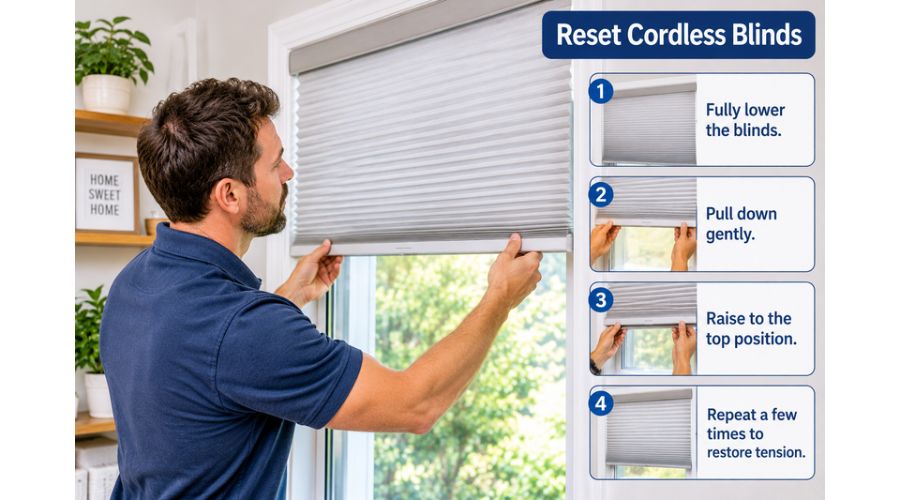
A standard tension reset is one of the simplest ways to restore cordless blind operation. It involves moving the blind through its full operating range so that the internal lifting mechanism can readjust.
This method is suitable for certain spring-assisted cordless blinds and shades, but not every design uses the same procedure.
Step 1: Fully lower the blinds
Hold the bottom rail near the center and lower the blinds slowly. Allow the blind to extend to its normal fully lowered position without forcing it beyond its designed travel limit.
If you are working with a cellular shade, allow the fabric to extend evenly. For horizontal blinds, make sure the slats are not caught against the window frame or another obstruction.
Lowering the blinds fully allows the lifting mechanism to move through its operating range.
Step 2: Pull the blinds down gently
Once the blinds are fully extended, check whether the bottom rail is level.
For models whose manufacturer recommends a tension-reactivation pull, give the bottom rail a few controlled downward tugs. These should be gentle and deliberate, not sharp jerks.
Some cordless cellular shades and mini blinds respond to this procedure because it helps reactivate the internal spring or tension device. If your product instructions do not recommend additional pulling, do not apply this step.
Step 3: Slowly raise the blinds
Hold the bottom rail evenly and lift it toward the headrail. Avoid lifting from only the left or right corner.
Raise the blind in a controlled manner, allowing the internal mechanism to work without sudden movements. If the blind begins to rise unevenly, stop and check whether the mounting brackets or fabric are interfering with movement.
Continue until the blind reaches its normal upper position.
Step 4: Repeat the operating cycle
Lower and raise the blind through its full range a few times, as long as it moves without unusual resistance.
Do not keep repeating the procedure if the blind remains stuck or becomes harder to operate. Several controlled cycles are generally enough to determine whether the mechanism has recovered.
Step 5: Test the selected height
Lower the blind to a comfortable position and gently release the bottom rail.
A properly functioning blind should remain at the selected height if its design supports intermediate positioning. Raise it again and check whether both sides move evenly.
If the blind now operates smoothly, the reset may have corrected a minor tension problem.
Method 2: Reset Blinds That Won’t Stay Up
If your cordless blinds won’t stay up, the internal lifting mechanism may not be holding the blind correctly. This is particularly frustrating because the blind may rise when you push it upward but gradually fall as soon as you release it.
A tension reset may help if the problem is caused by a mechanism that needs reactivation. However, it will not repair a broken spring or worn internal component.
Step 1: Lower the blinds completely
Start by lowering the blind to its normal bottom position. Hold the bottom rail evenly and move it down slowly.
Do not pull beyond the point where the blind naturally stops. Forcing it farther may stretch the internal cords or damage the lift mechanism.
Step 2: Inspect the bottom rail and headrail
Before raising the blind, check whether the bottom rail is straight and whether the headrail is properly seated in its mounting brackets.
Look for visible obstructions, tangled fabric, or objects that may be interfering with the movement.
If the blind is a cellular shade, check that the pleated fabric is not caught or folded unevenly. If it is a horizontal blind, check whether the slats are sitting properly.
Step 3: Lift the blinds manually
Hold the bottom rail at the center or support both ends evenly. Slowly lift the blind toward the headrail.
Avoid lifting one side higher than the other. Uneven operation can cause internal lift cords to move out of alignment.
Continue until the blind reaches its normal upper position.
Step 4: Hold briefly and release gently
Once the blind reaches the top, pause briefly before lowering it again.
This is not a universal locking procedure. The purpose is to let the mechanism complete its movement without rushing. Do not force the rail into the headrail or attempt to engage a component that is not designed to be manually operated.
Step 5: Test the blind at different heights
Lower the blind to a middle position and release it carefully.
If it stays in place, try another position. If it keeps sliding down, the spring or holding mechanism may need adjustment or repair.
Some cordless shades use adjustable tension systems, while others have factory-set mechanisms the homeowner can’t adjust. Check the product instructions before attempting any internal adjustment.
Method 3: Reset Blinds That Are Stuck
Cordless blinds can sometimes become stuck in the raised or lowered position. This may happen because of an obstruction, incorrectly seated mounting brackets, tangled internal cords, or a problem with the lifting mechanism.
Inspect carefully before resetting the tension.
Step 1: Inspect for obstructions
Look along the bottom rail, headrail, and sides of the blind.
Check whether the blind is touching a window handle, decorative trim, furniture, or another object that could prevent it from moving.
For horizontal blinds, look for slats that may have shifted or become caught. For cellular shades, check whether the fabric is trapped between the headrail and mounting bracket.
Remove any visible obstruction without pulling on the internal cords.
Step 2: Check the mounting brackets
Make sure the headrail is properly seated in its brackets.
A shifted bracket, or one pressing against the wrong part of the headrail, can interfere with the lift mechanism. Do not remove the blind from its brackets unless you know how the mounting system releases and can safely support the product.
If the blind is newly installed, check the installation instructions for the correct bracket positions.
Step 3: Remove accessible dust and debris
Use a soft cloth to wipe away dust from the accessible areas around the headrail and bottom rail.
Avoid inserting sharp objects into the mechanism. Do not use oil, grease, or household lubricants unless the manufacturer specifically recommends them. Certain products can damage plastic components, attract dust, or interfere with the spring assembly.
Step 4: Try a gentle downward movement
If the blind is designed to operate manually, hold the bottom rail evenly and lower it gently.
If it moves, continue slowly until it reaches its normal lower position. If it does not move or you encounter strong resistance, stop.
Never pull hard enough to bend the rail or stretch the internal cords.
Step 5: Cycle the blinds carefully
Once you remove the obstruction and the blind moves freely, raise and lower it through its normal range a few times.
Watch the bottom rail as it moves. Both ends should travel evenly, and the fabric or slats should remain properly aligned.
If the blind becomes stuck again, the problem may involve an internal component rather than a simple loss of tension.
Troubleshooting After the Reset
A reset does not always solve every cordless blind problem. Sometimes the underlying issue is a damaged spring, worn lift cord, misaligned mounting bracket, or failed operating component.
After attempting a reset, test the blinds carefully and compare their movement with how they operated when they were working properly.
Blinds Still Won’t Raise
If your cordless blinds still won’t rise after a reset, don’t keep pulling or pushing repeatedly. The problem may involve the internal lifting system.
Check for damaged internal springs.
The spring mechanism provides the force needed to help raise and hold the blind. If the spring is worn, disconnected, or damaged, the blind may remain at the bottom or rise only a short distance.
A failed spring may also cause the blind to move unevenly or lose its ability to hold a selected height.
Some mechanisms are replaceable, but others are integrated into the headrail. If the spring assembly is not designed for homeowner servicing, contact the manufacturer or a window-treatment repair professional.
Inspect the mounting brackets.
A headrail that is not properly seated may interfere with the lifting mechanism.
Check whether the brackets are secure and whether the headrail is sitting in the correct position. Look for visible bending, damage, or signs that the bracket is pressing against the moving components.
If you suspect that the brackets are incorrectly positioned, refer to the installation instructions before attempting to move them.
Check the blind’s weight and size.
Some cordless lift systems are designed for specific blind dimensions and weights. A replacement bottom rail, altered blind, or incorrectly sized component may affect how well the mechanism operates.
If the blind has been modified or fitted with parts that did not come with the original product, the lifting system may no longer be properly balanced.
Blinds Won’t Lower
When cordless blinds won’t go down, an obstruction or a mechanism that isn’t releasing properly may be the cause.
Look for tangled internal cords.
Although cordless blinds do not have an exposed operating cord, many designs still contain internal lift cords.
These cords help raise and lower the blind. If they twist, get trapped, or become uneven, the bottom rail may refuse to move smoothly.
Inspect only the accessible areas. Do not pull internal strings or attempt to untie them without model-specific instructions.
Check whether the mechanism is locked.
Some cordless designs use a spring, clutch, or other holding mechanism to maintain the blind at a selected height.
If the mechanism is jammed, the blind may resist downward movement. Try moving it gently in the direction the manufacturer recommends.
Do not assume that every blind has the same release mechanism. A procedure that works on one model may damage another.
Check for pressure from the brackets.
If the headrail is squeezed or incorrectly positioned in the mounting brackets, internal components may not move freely.
Look for visible misalignment and compare the installation with the manufacturer’s instructions. If the headrail appears damaged or trapped, seek assistance rather than forcing it out.
Blinds Are Uneven
Uneven cordless blinds can make a room look untidy and may indicate that the lifting components are not moving at the same rate.
Start from the lowest position.
If you can lower the blind safely, move it to its normal fully extended position.
Support the bottom rail evenly as you lower it. Avoid pulling one side down farther than the other.
Starting from the lowest position lets you check the alignment of the fabric, slats, and bottom rail.
Raise and lower the blind evenly.
Hold the bottom rail near its center or support both ends, following your model’s operating instructions.
Raise and lower it slowly through the normal operating range. This may help restore alignment if uneven tension, rather than damaged components, is causing the issue.
Check the installation
If one side remains higher, inspect the mounting brackets and the window frame level.
A blind installed on an uneven surface may hang crookedly even when its internal mechanism is functioning properly.
Do not try to fix a major alignment problem by repeatedly pulling one side. The internal cords may become more tangled.
Look for damaged lift components.
If the bottom rail remains uneven after careful operation, the problem may involve a damaged cord, pulley, spring, or internal tension assembly.
At this point, professional repair or replacement may be necessary.
Brand-Specific Reset Tips
Although the basic principles of resetting cordless blinds are similar, manufacturers use different lifting mechanisms and operating systems.
A procedure that works for one brand or product category may not apply to another. Always identify the product type before attempting a reset.
Resetting Levolor Cordless Blinds
Levolor manufactures several types of cordless window coverings, including cellular shades, roller shades, faux wood blinds, and other horizontal window treatments.
Because these products use different mechanisms, no single reset procedure applies to every Levolor cordless blind.
For a manually operated Levolor blind or shade that has become difficult to raise or lower, start by checking the bottom rail and headrail for visible obstructions. Make sure the blind is correctly seated in its mounting brackets.
If the product uses a compatible spring-assisted lift system, follow the model’s instructions for operating the blind through its full range. Some cordless shades can recover normal movement after you reactivate their tension mechanism.
If you are trying to reset Levolor cordless blinds that will not stay up, avoid opening the headrail or turning an internal adjustment screw unless the manual specifically identifies that adjustment.
For motorized Levolor shades, the reset procedure may be completely different. Certain motorized products have electronic calibration functions that reset the travel limits rather than the mechanical tension.
For example, a Levolor Premier motorized blind instruction document describes a calibration reset involving the control button and the blind’s travel limits. That procedure is intended for the specified motorized system, not ordinary manual cordless blinds.
The best approach is to identify the product and consult the appropriate support material.
Resetting Bali Cordless Blinds
Bali offers cordless cellular shades, horizontal blinds, roller shades, and other window coverings.
Its troubleshooting resources provide different instructions depending on the product type and lift system.
If your Bali cordless shade won’t raise or lower properly, first check whether the shade is obstructed or seated incorrectly in its mounting brackets.
For some compatible cordless cellular shades, a tension reset involves fully extending the shade, then raising it by pushing upward near the middle of the bottom rail. You may need to repeat the movement carefully to reactivate the lifting mechanism.
If the shade still isn’t operating correctly, consult the troubleshooting guide for your model. Bali provides separate resources for issues such as uneven shades, creeping movement, and lift-system problems.
Do not assume that the instructions for a cellular shade also apply to a Bali horizontal blind or roller shade.
Resetting Allen + Roth Cordless Blinds
Allen + Roth cordless blinds are available in several designs, including faux wood horizontal blinds, cellular shades, and cordless roller shades.
The reset process depends on whether you have a manually operated blind or a motorized shade.
For manual Allen + Roth cordless faux wood blinds, raise the blind by lifting the bottom rail and lower it by pulling the rail down. Operate it evenly rather than lifting from one side.
If the blind will not rise, you can check whether the mechanism responds to a full-range operating cycle. Some owners have reported that fully lowering the blind and then gently pulling the bottom rail to its normal lower limit restores operation. However, do not treat this as a universal instruction for every Allen + Roth model.
If the blind is difficult to lower, check the headrail, mounting brackets, and accessible lift components for obstruction. Avoid opening the mechanism or adjusting internal cords without the correct model instructions.
Motorized Allen + Roth shades require a different approach. They may use a remote, rechargeable battery, and an electronic programming system. A remote-controlled reset can clear programming, but it does not necessarily repair the shade’s motor or reset the mechanical tension.
If you have a motorized model, find its model number and follow the correct programming instructions instead of using the manual blind reset method.
When Manufacturer Instructions Differ
Understanding why brand-specific instructions matter is important.
A cordless cellular shade may use a spring-assisted mechanism, while a cordless roller shade may use a spring inside its roller assembly. Horizontal faux wood blinds may use internal lift cords and a different type of tension mechanism.
Even products from the same manufacturer can have different operating systems depending on their age, model, size, and design.
For this reason, do not automatically apply a reset procedure from one brand to another.
Before attempting a reset, identify:
- The manufacturer and product name.
- Whether the blind is manual or motorized.
- Whether it is a cellular, roller, faux wood, aluminum, or another type of blind.
- The model number, if available.
- The symptoms you are experiencing.
If the manufacturer’s instructions recommend a different procedure from the general methods in this article, follow the manufacturer’s instructions.
When a Reset Doesn’t Fix the Problem
Sometimes resetting cordless blinds will not restore normal operation. This usually happens when an internal component is worn, broken, or incorrectly installed.
Continuing to operate a damaged blind can make the problem worse. Instead of repeatedly resetting the tension, determine whether the mechanism needs professional attention.
Signs of Mechanical Failure
Several symptoms suggest that your cordless blind may have a mechanical problem rather than a simple tension issue.
The blind falls immediately after being raised.
If the blind cannot hold any position and drops as soon as you release the bottom rail, the internal holding mechanism may be damaged or worn.
The bottom rail moves unevenly.
A bottom rail that consistently rises higher on one side may indicate tangled internal cords, a damaged pulley, or an uneven lifting mechanism.
The blind makes unusual noises.
Clicking, grinding, or repeated snapping sounds may indicate that internal components are slipping or rubbing against each other.
Stop operating the blind if you hear unusual noises, especially if the movement becomes increasingly difficult.
The blind is completely stuck.
If the blind refuses to move in either direction despite having no visible obstruction, the spring, clutch, or lift assembly may have failed.
The fabric or slats are visibly damaged.
Torn fabric, bent slats, broken end caps, and damaged bottom rails can interfere with normal operation. A tension reset will not repair these physical defects.
When Parts Need Replacement
If the reset does not solve the problem, you may need to replace a damaged component.
Depending on the design, the affected part could include:
- Internal spring or spring motor.
- Lift cords or internal cord guides.
- Pulley or clutch assembly.
- Bottom rail or end caps.
- Mounting brackets.
- Roller shade tension components.
- Motor or electronic control components (motorized models).
Before ordering replacement parts, make sure they match your exact blind model. Components that look similar may have different dimensions or operating requirements.
Some manufacturers supply replacement parts directly, while others require an authorized service provider to complete repairs.
Avoid cutting internal cords or dismantling the spring assembly as a first repair attempt. Doing so can make the blind unsafe or more expensive to repair.
Contacting Customer Support or Warranty Services
If the blinds are relatively new or still under warranty, contact the manufacturer before attempting extensive repairs.
Keep the following information available:
- Brand and model number.
- Approximate purchase date.
- Proof of purchase, if available.
- Description of the problem.
- Steps you have already tried.
- Photographs or a short video showing the fault.
Customer support may identify the correct reset procedure, recommend a replacement component, or arrange a warranty repair.
If the blind is old or the internal mechanism isn’t replaceable, replacing the entire blind may be more economical than repairing it.
Frequently Asked Questions
Why Won’t My Cordless Blinds Stay Up?
Cordless blinds may refuse to stay up because the internal spring or tension mechanism no longer holds the weight properly. This can happen after extended periods without operation, normal wear, or damage to the lifting components.
Start by lowering the blind completely and checking for visible obstructions. If your model supports a tension-reactivation reset, follow the manufacturer’s instructions for operating the blind through its full range.
If the blind still falls, the spring, clutch, or another internal component may need repair or replacement.
How Often Should Cordless Blinds Be Reset?
You do not need to reset cordless blinds on a fixed schedule if they are working correctly.
You generally reset a blind when it develops an operating problem, such as refusing to stay up, moving unevenly, or becoming sluggish.
Regularly raising and lowering your blinds through their normal operating range can help maintain smooth movement. Also remove dust, avoid pulling the bottom rail from one side, and follow the manufacturer’s maintenance instructions.
If the blind needs repeated resets to work properly, investigate the underlying problem rather than treating resetting as routine maintenance.
Can Resetting Damage My Blinds?
Resetting cordless blinds should not damage them when you follow the correct procedure for the specific model.
However, pulling too hard, forcing a stuck bottom rail, repeatedly jerking the blind, or opening the headrail without proper instructions can damage the spring, internal cords, or other components.
Always operate the blind slowly and evenly. Stop if you encounter unusual resistance or hear cracking and grinding sounds.
A reset is intended to restore normal movement, not force a damaged mechanism to work.
Do All Cordless Blinds Reset the Same Way?
No. Cordless blinds use different lifting systems depending on their design and manufacturer.
Some spring-assisted cellular shades can be reset by fully extending the shade, then carefully raising it from the middle of the bottom rail. Certain horizontal blinds also respond to controlled full-range movement.
Cordless roller shades may have different spring-tension adjustments, while motorized shades can require electronic calibration or remote programming.
Always identify the product type and follow its specific instructions before attempting a reset.
A video showing how to factory reset a motorized Blind
Conclusion
Resetting cordless blinds is often a simple way to restore normal operation when the problem involves lost tension, uneven movement, or a mechanism that needs reactivation. Start by identifying the blind type, checking for obstructions, and making sure the headrail is seated correctly in its mounting brackets.
For compatible manual models, a careful full-range operating cycle may help restore the spring or tension mechanism. If your cordless blinds won’t stay up, won’t go down, or have become stuck, avoid forcing the bottom rail. Instead, follow the appropriate troubleshooting method and test the blind after each adjustment.
Remember that Levolor, Bali, and Allen + Roth cordless blinds do not necessarily use identical mechanisms. Manufacturer-specific instructions should take priority over general reset methods, especially for motorized shades or internal tension adjustments.
Regular cleaning and correct operation can help prevent many common problems. If resetting does not fix the issue, inspect the blind for signs of mechanical failure and consider replacing the damaged component or contacting customer support.
With the right approach, you may be able to fix cordless blinds without replacing the entire window covering. However, when the internal lift mechanism is broken or worn beyond repair, professional assistance is usually the safest and most reliable option.