
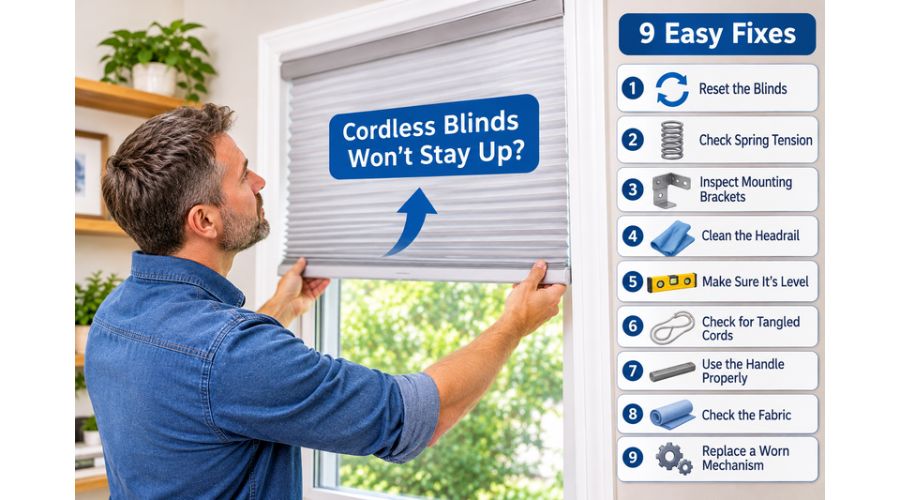
Cordless blinds make controlling natural light easier. Lift the bottom rail to open them, then pull them down to cover the window. No dangling operating cords to manage, and the clean look works well in bedrooms, living rooms, offices, and other spaces.
However, the convenience disappears when your cordless blinds won’t stay up. You raise them to the position you want, release the bottom rail, and watch the shade slowly slide back down.
This problem is frustrating, but it does not always mean you need to buy new blinds. In many cases, the cause is low spring tension, an obstruction in the headrail, incorrect installation, a damaged lift mechanism, or a problem with how the blind is operated. Some issues you can fix without removing the window covering, while others require replacement parts or professional help.
If your cordless blinds keep falling, this guide will help you identify the cause and work through nine practical fixes. You will also learn how to troubleshoot different types of cordless window coverings, recognize when a mechanism has failed, and decide whether repair or replacement makes more sense.
Also Read:
Why Won’t My Cordless Blinds Stay Up?
If your cordless blinds won’t stay up after you raise them, the first thing to understand is that different cordless products use different lifting systems. Many cellular, pleated, and roller shades use a spring-assisted mechanism that offers resistance and helps hold the shade at a selected height.
Some horizontal blinds use lift cords and locking components hidden inside the headrail. Motorized shades use an electronic drive system and may need calibration rather than a manual tension adjustment.
The exact cause therefore depends on the type and model of your blind. A fix that works for a spring-assisted cellular shade may not be appropriate for a cordless horizontal blind or a motorized roller shade.
The most common causes include:
- Reduced spring tension: The internal spring may no longer provide enough resistance to hold the shade at the selected height.
- A worn or damaged lift mechanism: A clutch, lock, gear, or other internal component may be slipping.
- An obstruction in the headrail: Dust, debris, or a displaced component may interfere with normal operation.
- Incorrect installation: Crooked or tightly positioned mounting brackets can put pressure on the mechanism.
- Uneven lifting: Pulling one side more than the other can tilt the bottom rail and cause the shade to move poorly.
- Incorrect operation: Raising the blind too quickly or gripping it in the wrong place may interfere with some models.
- Fabric or material problems: A twisted, stretched, or improperly positioned shade can affect how it moves.
- Loose or damaged parts: A broken handle, loose end cap, or damaged internal connection may prevent the blind from holding its position.
Before attempting a repair, identify whether you have a cellular shade, pleated shade, roller shade, or horizontal blind. If possible, check the brand and model number. This small step can prevent you from applying the wrong adjustment to a mechanism that works differently from the one described in a general tutorial.
Cordess Blinds Won’t Stay Up (9 Easy Fixes)
The following fixes cover common problems found in manual cordless blinds and shades. Start with the least invasive checks before attempting adjustments that require tools or removal. Stop if you encounter unusual resistance, a broken component, or instructions that conflict with your manufacturer’s guidance.
1. Reset the Cordless Blinds by Operating Them Through Their Full Range
A reset is a sensible first step when the shade is difficult to position or doesn’t behave consistently. On some spring-assisted models, operating the blind through its normal range can help the internal mechanism return to a more regular operating position. However, it is not a universal repair and will not restore a broken spring or damaged clutch.
How to reset cordless blinds:
- Stand directly in front of the window and hold the bottom rail with both hands.
- Gently lower the blind to its normal fully extended position. Do not pull beyond the designed stopping point.
- Keep the bottom rail level as you operate it.
- Raise the blind smoothly toward the top of the window.
- Repeat the normal lowering and raising movement a few times if the manufacturer recommends this procedure.
- Test whether the shade now holds at several positions.
Avoid jerking the bottom rail or forcing the shade against the headrail. If it suddenly becomes difficult to move, stop and investigate rather than applying more force.
This method is most appropriate for compatible manual cordless shades. A motorized shade may require a specific reset sequence involving its control button, remote, or travel-limit settings. Do not use a manual spring-reset procedure on a motorized product unless its instructions specifically recommend it.
If the blind still slides down immediately after you raise it, move on to the next checks. Repeatedly cycling a damaged mechanism is unlikely to solve the problem.
2. Check Whether the Spring Tension Needs Adjustment
Low spring tension may be why cordless blinds keep falling. In a spring-assisted shade, the spring helps counterbalance the weight of the material and bottom rail. When the mechanism loses its ability to hold the shade, the blind may gradually creep downward after you release it.
Some products have a manufacturer-approved tension adjustment. Others are sealed, and owners can’t safely retension them. The adjustment method can also differ between cellular shades, roller shades, and other designs.
How to check for a tension problem:
- Raise the shade halfway up the window.
- Release the bottom rail gently.
- Observe whether it stays in place, drops immediately, or slowly creeps down.
- Repeat the test at another height.
- Check whether the problem occurs evenly across the entire width or mainly on one side.
If the shade consistently slips downward even though it moves smoothly, the spring or holding mechanism may be losing tension. Consult the product manual for an approved adjustment procedure before removing covers or turning internal components.
Do not twist an exposed spring, wind a mechanism by guesswork, or dismantle a sealed headrail. Springs can store energy, and an incorrect adjustment can damage the shade or cause injury. If the product does not have a documented owner adjustment, contact the manufacturer or a blind repair professional.
3. Inspect the Mounting Brackets and Headrail
Incorrect installation can make a perfectly good blind difficult to operate. If the headrail is tilted, squeezed, or not fully seated in its brackets, the internal mechanism may bind. This can make the shade feel heavy, cause uneven movement, or prevent it from holding its position.
Check the brackets before assuming that the spring has failed.
What to inspect:
- Confirm that both mounting brackets are firmly attached.
- Check whether the headrail is level.
- Make sure the headrail is seated correctly in the brackets.
- Look for signs that the window frame is pressing against either end of the shade.
- Check whether the blind is rubbing against the window casing.
- Look for screws that protrude into the space where the headrail needs to sit.
If the shade is installed inside the window frame, ensure there is enough clearance for the headrail and moving components. A tight opening can put pressure on the ends of the blind and interfere with movement.
If you find a loose bracket, secure it using the correct fastener for the mounting surface. If the bracket is bent or cracked, replace it with the correct part rather than trying to force it back into shape.
Some manufacturers recommend testing a shade outside its mounting brackets to determine whether the brackets are causing the problem. That procedure is model-specific and may require a second person to support the shade. Follow the product instructions before removing it. Do not allow a wide or heavy blind to fall while you are working.
4. Clean Dust and Debris From the Headrail
Dust may seem harmless, but a buildup inside the headrail can interfere with moving components. This is especially true in homes where blinds are exposed to open windows, cooking residue, pet hair, or frequent dust buildup.
The headrail contains the parts that lift, balance, or lock the shade. If debris collects around these components, movement may become rough or inconsistent. Cleaning may help when an obstruction causes the problem, although it will not repair worn springs, broken gears, or damaged clutches.
How to clean cordless blinds safely:
- Lower the blind to a comfortable working position.
- Use a soft, dry microfiber cloth to remove dust from the headrail and exposed surfaces.
- Use a soft brush attachment on a vacuum cleaner to collect loose dust around accessible openings.
- Wipe the bottom rail and side edges.
- Check for visible debris trapped around the operating components.
- Test the blind gently after cleaning.
Avoid spraying water or household cleaning products into the headrail. Moisture can damage some metal components, affect adhesives, or stain fabric. Do not insert sharp objects into narrow openings to dislodge dirt.
If you can see a loose piece of plastic or a broken component inside the headrail, do not push it deeper into the mechanism. Identify the part and check whether the manufacturer offers a replacement.
5. Make Sure the Bottom Rail Is Level
A crooked bottom rail can cause the shade to lift unevenly. When one side rises faster than the other, the material may bunch up, twist, or rub against the window frame. This can make it seem as though the cordless blinds won’t stay up, even when the main lifting mechanism is still functional.
Uneven movement may be caused by an unlevel installation, an incorrectly positioned handle, a damaged internal lift component, or a problem with the shade material.
How to check the bottom rail:
- Lower the shade until the bottom rail is visible.
- Stand back and compare both ends with the window frame.
- Check whether one side sits lower than the other.
- Raise the shade slowly while watching whether both ends move together.
- Look for fabric folds or sections that appear twisted.
For a simple cordless blind, the manufacturer’s instructions may provide a specific adjustment for leveling the bottom rail. Some models have adjustment features beneath the headrail; others require a different procedure. Don’t assume every blind has the same adjustment points.
If the brackets are not level, correct their alignment first. If the brackets are level but the bottom rail remains crooked, consult the product-specific guide. A damaged lift cord or internal component may need repair.
6. Check for Tangled, Pinched or Damaged Lift Cords
Some products marketed as cordless still contain internal lift cords. These cords are concealed within the blind rather than hanging down as operating cords. They work with the lifting mechanism to raise and support the shade.
If an internal cord becomes tangled, pinched, frayed, or disconnected, the shade may move unevenly or fail to hold its position. This can happen after years of use or when the blind has been operated roughly.
Look for these warning signs:
- One side of the shade rises while the other remains low.
- The bottom rail tilts during operation.
- The blind catches at the same point each time.
- You hear unusual clicking or grinding sounds.
- The material bunches up instead of folding evenly.
- The blind suddenly drops after previously working normally.
Do not pull on visible internal cords or attempt to tie them together. The correct repair may involve replacing a lift cord, repairing a cord guide, or servicing the internal mechanism. The procedure differs by model.
If the cord is damaged or has come loose inside the headrail, consult the manufacturer before opening the unit. A professional can determine whether the cord can be replaced or whether the complete lift assembly needs to be changed.
7. Check the Handle and Operating Technique
A loose or damaged handle can make a cordless shade difficult to control. The handle is the part you grip when raising or lowering many cellular and pleated shades. If it has detached, shifted, or cracked, you may be pulling the bottom rail unevenly.
Operating technique also matters. Some horizontal cordless blinds have a specific release button or lifting action. Some models require the bottom rail to be held level, while others are designed to be operated from a specific point.
Try these checks:
- Inspect the handle for cracks or movement.
- Confirm that it is positioned securely.
- Hold the bottom rail with both hands when the shade is wide.
- Apply even pressure on both sides.
- Move the shade smoothly rather than pulling sharply.
- If your model has a release button, follow the manual’s operating instructions.
Don’t assume all cordless blinds lift the same way. For example, a simple cordless horizontal blind may use a center button, while a cellular shade may be operated by holding the bottom rail or a designated handle.
If the handle is broken, use the correct replacement part. Avoid attaching a makeshift handle with adhesive or screws unless the manufacturer approves that repair. An incorrectly positioned handle can put extra pressure on the bottom rail or interfere with the shade’s movement.
8. Look for Fabric, Roller or Material Problems
Not every case of window shades falling is caused by the spring. The material itself can affect how a blind moves. Fabric may twist, crease, stretch, or get caught around a roller. Cellular shades may develop uneven folds, while roller shades may shift toward one side.
For roller shades, inspect the fabric as it moves. It should roll evenly around the tube without bunching or rubbing against the brackets. If the material is not tracking correctly, the shade may become difficult to position.
For cellular shades, check whether the pleats are folding evenly. Look for crushed sections, fabric caught behind the bottom rail, or visible damage near the sides.
What you can do:
- Remove loose dust using a suitable soft brush or cloth.
- Check that the material is not caught against the window frame.
- Operate the shade slowly and observe where the fabric begins to twist.
- Make sure furniture or window hardware isn’t blocking the bottom rail.
- Consult the manufacturer’s instructions for fabric alignment or length adjustments.
Do not pull hard on stretched or damaged fabric. Do not apply heat, steam, or household chemicals unless the care instructions specifically allow them. If the fabric has separated from its rail or roller, it may need professional reattachment or replacement.
9. Replace a Worn or Damaged Lift Mechanism
If you have checked the installation, cleaned the headrail, tested the operating technique, and followed the manufacturer’s reset procedure without success, the internal mechanism may be worn or damaged.
A lift mechanism can contain springs, clutches, gears, cord guides, locking components, or other parts, depending on the design. When one of these components fails, the shade may no longer hold its position.
Common signs of mechanism failure include:
- The blind drops as soon as you release it.
- The shade cannot remain at any height.
- The bottom rail moves but the fabric does not respond correctly.
- The mechanism makes repeated clicking or grinding noises.
- The shade becomes unusually difficult to raise.
- The blind works intermittently.
Some brands offer replacement components or repair services. Others may recommend replacing the complete operating assembly or the shade itself. Before ordering parts, confirm the exact product type, model, width, and manufacturing period. A similar-looking component may not fit or work correctly.
If the blind is still under warranty, contact the manufacturer before dismantling it. Opening the headrail or modifying the spring assembly may affect warranty coverage.
Can You Fix Cordless Blinds Without Taking Them Down?
Yes. You can check and sometimes fix several cordless blind problems while the blind remains installed. You can inspect the brackets, check the bottom rail, remove surface dust, examine the handle, and test the normal lifting movement without taking the shade down.
Start with these simple checks:
- Test the movement: Raise and lower the shade gently to identify where it starts slipping.
- Check the alignment: Look at the headrail and bottom rail to see whether either is crooked.
- Inspect the brackets: Confirm that the headrail is seated properly and that the brackets are secure.
- Clean accessible areas: Remove dust from the headrail, bottom rail, and fabric.
- Check for obstructions: Make sure the shade is not rubbing against the window frame or caught on an object.
However, you can’t complete some repairs safely while the blind is mounted. Replacing an internal spring, repairing a lift cord, or accessing a sealed clutch may require removing the shade. Support wide or heavy blinds with another person during removal.
If your shade is difficult to remove, do not force it out of the brackets. Some mounting systems use clips or release tabs that must be operated in a particular way. Check the installation instructions first.
Why Do New Cordless Blinds Keep Falling?
It can be especially frustrating when new cordless blinds won’t stay up. You expect a recently purchased shade to operate smoothly, so a blind that drops after installation may seem defective. Sometimes it is, but other explanations are possible.
Incorrect installation
The brackets may not be level, the headrail may not be fully secured, or the shade may be too tightly fitted inside the window opening. These problems can place pressure on the operating mechanism.
Incorrect operation
Some cordless blinds have specific operating instructions. A horizontal blind may require you to press a release button, while a cellular shade may need an even grip across the bottom rail. Operating the product incorrectly can cause inconsistent movement.
A product defect
A new shade may have a faulty spring, clutch, locking component, or internal connection. If it slips from the first day of use despite correct installation and operation, contact the seller or manufacturer.
Incorrect size or fit
A shade that is too wide for the opening may rub against the sides. A poor fit can interfere with movement and make the blind feel as though it is losing tension.
Shipping or handling damage
A blind can be damaged during transportation or installation. A bent headrail, cracked bracket, or displaced internal component may not be obvious until you begin using it.
What should you do? Check the installation guide, confirm the correct operating method, and inspect the brackets. If the shade still falls, document the problem and contact the retailer. Avoid dismantling a new product before checking the warranty or return policy.
Brand-Specific Fixes for Cordless Blinds That Won’t Stay Up
Although the basic symptoms are similar, brands and product lines use different lifting mechanisms. A procedure that works on one model may damage another. Always identify the exact product before adjusting internal components.
Levolor Cordless Blinds Won’t Stay Up
Levolor offers several types of cordless window coverings, including cellular shades, roller shades, and horizontal blinds. Their troubleshooting procedures are not identical.
For some Levolor horizontal blinds, the manufacturer recommends checking whether the headrail is obstructed and whether lift cords are pinched or tangled when the blind does not raise or lower evenly. Certain simple cordless models also have specific leveling adjustments beneath the headrail. These instructions are model-specific and should not be applied to every Levolor product.
If your Levolor blind keeps falling, start by checking:
- Whether the headrail is level and correctly seated.
- Whether the bottom rail is straight.
- Whether any visible obstruction is interfering with movement.
- Whether the handle or operating button works correctly.
- Whether the product manual includes an approved adjustment.
For a roller or cellular shade, use the instructions for that exact shade type. Do not assume that a horizontal blind’s skew adjustment is suitable for a spring-assisted cellular shade.
Bali Cordless Blinds Won’t Stay Up
Bali provides separate troubleshooting instructions for cellular shades and horizontal blinds. Its support resources include guidance for cordless products that creep down, rise unevenly, or don’t operate correctly. The correct procedure depends on the product type and, in some cases, the manufacturing period.
If your Bali cordless cellular shade keeps falling, check the official troubleshooting guide for the specific problem. Bali distinguishes between issues such as creeping down, creeping up, uneven movement, and incorrect operation. That distinction matters because each symptom may have a different cause.
For example, Bali’s published guidance for certain cordless cellular and pleated shades describes checking the installation brackets and testing the shade’s operation. It also provides model-specific procedures for correcting certain operating problems. Do not remove the dust cover or turn an internal rod unless your model’s instructions require it.
Home Decorators Collection Cordless Blinds Issues
Home Decorators Collection blinds are sold in different styles and configurations. The repair method depends on whether you have a cellular shade, roller shade, faux wood blind, or another type of window covering.
If your Home Decorators Collection cordless blinds won’t stay up, first identify the model and check the instructions supplied with the product. Look for the manufacturer’s name, product number, or model information on the packaging, purchase receipt, or installation paperwork.
Check the following:
- Whether the headrail is seated correctly.
- Whether the shade is rubbing against the window frame.
- Whether the bottom rail is level.
- Whether the handle is damaged or loose.
- Whether the product has a documented reset or tension-adjustment procedure.
If the blind is relatively new, contact the retailer before attempting internal repairs. The product may qualify for a replacement or warranty service. Avoid using a generic spring-tension procedure unless the instructions specifically say it’s suitable for your model.
Allen + Roth Cordless Shades Troubleshooting
Allen + Roth cordless shades are available in different designs, including roller shades. Their internal mechanisms may not be adjustable in the same way as those found in other brands.
For example, a Lowe’s customer-support discussion about an Allen + Roth Simple Rise cordless roller shade describes a shade that retracts slowly and drops when placed at a partially closed position. The discussion includes a response from the Allen + Roth team directing the customer to contact support. This is a useful reminder that not every cordless shade can be retensioned by the owner.
If your Allen + Roth shade keeps falling:
- Check that it is installed according to the instructions.
- Make sure the fabric is not caught or rubbing against the frame.
- Inspect the brackets and bottom rail.
- Follow the operating instructions for the exact model.
- Contact Lowe’s or the product support team if the shade keeps slipping.
Do not open the roller mechanism or attempt to wind the spring by hand unless the manufacturer provides an approved procedure.
Repair Cost vs. Replacement Cost: Which Is Better?
When cordless blinds won’t stay up, whether to repair or replace them depends on the extent of the damage, the product’s age, the availability of replacement parts, and the cost of professional labor.
A minor problem such as a loose bracket or an incorrectly seated headrail may cost very little to correct. A damaged lift mechanism can be more expensive because the repair may require a replacement assembly and additional labor.
When repair makes sense
Repair is usually worth considering when:
- The blind is relatively new.
- The fabric and headrail are in good condition.
- The problem is limited to a replaceable component.
- The manufacturer sells compatible parts.
- A warranty covers the product.
- The repair cost is substantially lower than buying a replacement.
When replacement makes more sense
Replacement may be the better option when:
- The spring or lift mechanism is badly damaged.
- Several components have failed.
- The fabric is torn, badly stained, or stretched.
- Replacement parts are unavailable.
- The blind is old and has experienced repeated problems.
- Professional repair costs approach the price of a new blind.
What affects the cost?
The total cost can include the replacement mechanism, brackets, lift cords, labor, and any additional parts needed to restore the shade. Custom blinds may also be more expensive to replace because their dimensions and components are made for a specific window.
Rather than relying on a generic online repair estimate, request a quote based on the exact brand, model, size, and fault. Compare that quote with the cost of a suitable replacement.
If the product is still under warranty, check the terms before paying for repairs. A manufacturer may provide replacement parts or service for qualifying defects.
Common Mistakes That Make Cordless Blinds Worse
When a blind refuses to stay up, it is tempting to pull harder or try a repair you have seen demonstrated on another model. Unfortunately, some common approaches can turn a minor problem into a costly replacement.
1. Pulling the Bottom Rail Too Hard
A cordless blind is designed to move smoothly. Pulling sharply can put unnecessary pressure on the internal lifting components, handles, and fabric. Use steady, even pressure instead.
2. Forcing a Stuck Blind
If the shade stops moving, don’t force it up or down. Something may be obstructing the headrail, or the mechanism may have failed. Identify the cause before operating it again.
3. Applying Oil or Grease to the Mechanism
Lubricants may attract dust, stain the fabric, or damage certain plastic components. Only use a lubricant if the manufacturer specifically recommends one for your model.
4. Opening the Headrail Without Instructions
The headrail may contain spring-loaded components or delicate parts. Opening it without understanding the mechanism can cause damage or injury. Use the product’s repair guide or seek professional assistance.
5. Copying a Reset Method From a Different Brand
Cordless cellular shades, roller shades, and horizontal blinds do not all use the same lifting system. A reset procedure that works for one product may not work for another.
6. Ignoring Uneven Mounting Brackets
A crooked headrail can cause repeated operating problems. Replacing the spring will not necessarily fix a shade that is incorrectly installed.
7. Continuing to Use a Damaged Blind
Do not force a shade that makes grinding noises, drops suddenly, or has a visibly broken component through repeated operating cycles. Stop using it until you have assessed the fault.
8. Using Improvised Replacement Parts
A handle, cord guide, or bracket that looks similar may not be compatible. Incorrect parts can affect the blind’s balance and safe operation. Use components approved for the exact model.
How to Prevent Cordless Blinds From Falling Again
Once you have restored normal operation, a little maintenance can help reduce the risk of another problem. Cordless blinds do not require complicated upkeep, but they benefit from careful handling and occasional inspection.
Operate the shade smoothly. Raise and lower it using the recommended grip or control. Avoid jerking the bottom rail or forcing it past its normal travel limits.
Keep the headrail clean. Remove dust regularly using a soft cloth or brush attachment. Do not spray cleaning products into the operating mechanism.
Check the mounting brackets. Inspect the brackets occasionally to make sure they remain secure and aligned. Loose or shifted brackets can affect the way the blind moves.
Watch for uneven movement. If one side starts to rise faster than the other, investigate the cause before the problem worsens.
Follow the manufacturer’s care instructions. Different materials need different cleaning methods. Cellular fabric, roller fabric, faux wood, and aluminum slats should not be cleaned the same way.
Avoid unnecessary adjustments. If the shade works correctly, do not dismantle it or alter its spring tension without a reason. Unnecessary adjustments can introduce problems that weren’t there before.
Frequently Asked Questions
1. Why Won’t My Cordless Blinds Stay Up?
Cordless blinds may fail to stay up because of low spring tension, a worn clutch or locking mechanism, tangled internal lift cords, dust buildup, or incorrect installation. A crooked headrail can also interfere with normal operation. Start by checking the brackets, bottom rail, and operating technique. If the shade still slips, consult the model-specific troubleshooting instructions to determine whether the internal mechanism needs adjustment or replacement.
2. How Do I Tighten Cordless Blinds?
The method depends on the blind type and model. Some spring-assisted shades have manufacturer-approved tension adjustments, while others use sealed mechanisms that owners should not open. Begin by checking the product manual for a tension-reset procedure. Do not twist springs, turn internal rods, or dismantle the headrail by guesswork. If the manual doesn’t provide an owner adjustment, contact the manufacturer or a repair professional.
3. Can Cordless Blinds Be Repaired?
Yes. Many cordless blinds can be repaired if the problem is limited to a replaceable part such as a bracket, handle, lift cord, clutch, or operating mechanism. Part availability depends on the shade’s brand, model, and age. You may also fix minor installation problems without replacing the entire blind. If the fabric is badly damaged or the mechanism is no longer supported, replacement may be more practical.
4. Why Do Cordless Shades Keep Falling?
Cordless shades keep falling when the mechanism cannot hold the shade’s weight at the selected height. A weakened spring, worn clutch, damaged lock, or internal cord problem may be responsible. Incorrect installation and an obstructed headrail can also contribute. If the shade gradually creeps down, inspect the mounting and follow the manufacturer’s troubleshooting guide before deciding that the spring needs replacement.
5. How Long Do Cordless Blinds Last?
The lifespan of cordless blinds varies with product quality, materials, frequency of use, installation, and maintenance. A well-made blind that is operated correctly may provide years of service, while a heavily used or poorly installed product may develop problems sooner. Fabric damage, worn lifting components, and exposure to moisture or excessive heat can shorten its useful life. Inspect the shade regularly and address operating problems early.
6. Should I Repair or Replace Cordless Blinds?
Repair is usually worth considering when the blind is in good condition, and the problem involves a replaceable component. Replacement may be more practical when the headrail, fabric, or several internal parts are badly damaged, or when compatible replacement parts are unavailable. Compare the repair quote with the cost of a suitable new blind. If the product is under warranty, contact the manufacturer before paying for repairs.
7. Can Dust Make Cordless Blinds Stop Working?
Yes, dust and debris can interfere with accessible moving components and make some blinds operate less smoothly. Buildup around the headrail may contribute to sticking or uneven movement. Clean the exposed surfaces with a soft cloth or suitable brush attachment, and follow the manufacturer’s care instructions. Do not spray water or cleaning chemicals into the mechanism. Cleaning may clear an obstruction, but it will not repair a broken spring or clutch.
8. How Do You Reset Cordless Blinds?
For some manual spring-assisted shades, a reset may involve gently lowering the blind to its normal extended position and raising it again through its usual range. Keep the bottom rail level and never force it beyond its stopping point. Repeat only if the manufacturer recommends doing so. Motorized shades and certain horizontal blinds require different procedures, so check the model-specific instructions before attempting a reset.
The video below demonstrates how to fix a cordless blind that won’t lift
Conclusion
When your cordless blinds won’t stay up, the problem often involves the lifting mechanism, installation, internal cords, or an obstruction in the headrail. Fortunately, you do not always need to replace the entire window covering.
Checking the brackets, cleaning accessible areas, operating the shade correctly, and following the manufacturer’s reset instructions can help resolve some common problems.
Start with the simple checks before attempting an internal repair. If the blind keeps sliding down, makes unusual noises, or has a visibly damaged component, stop forcing it and identify the correct replacement part or service option. Brand-specific instructions matter because Levolor, Bali, Home Decorators Collection, and Allen + Roth products don’t all use the same mechanisms.
With the correct diagnosis and repair method, you may be able to restore your cordless blinds without the expense of replacing the entire unit.