
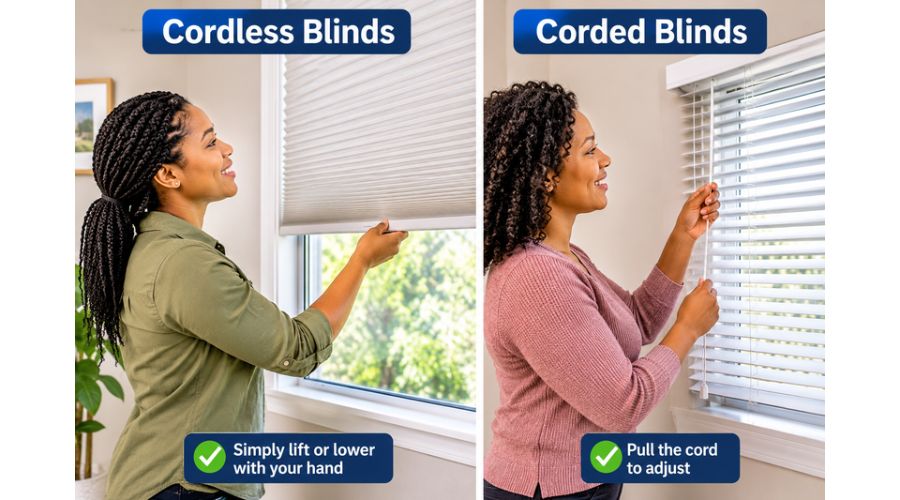
Choosing the right window blinds is about more than finding a design that matches your furniture or wall color. You also need to consider how easy they are to operate, how much privacy they provide, how well they control sunlight, and whether they are safe for everyone in your home.
Corded and cordless blinds are two common options, and although they perform the same basic function, they differ considerably in how they work and how convenient they are to use. Understanding these differences can help you avoid buying blinds that become frustrating to operate or unsuitable for your household.
Between corded and cordless blinds, cordless blinds are the better choice for most homes. Cordless blinds offer a cleaner appearance, are easier to operate, and eliminate the need for exposed operating cords that can become tangled or create safety hazards.
You can raise or lower many cordless models by gently pushing or pulling the bottom rail, making them particularly convenient for everyday use. Besides, they are a strong option for homes with children and pets because they do not have the dangling operating cords found on traditional blinds.
Although corded blinds can be less expensive and may suit certain large or heavy window coverings, the convenience, appearance, and safety advantages of cordless blinds make them the better overall investment.
Also Read
Cordless Blinds
Cordless blinds are window coverings designed to open, close, and adjust without requiring you to pull an external cord or chain. Instead of using a hanging cord to control the movement of the blind, they rely on a built-in operating mechanism.
Depending on the design, you may operate them by holding the bottom rail, using a small handle, or pressing a button on a motorized system.
Unlike traditional blinds, cordless models do not have long operating cords hanging beside the window. This gives them a neat, uncluttered appearance and makes them easier to use in rooms where people frequently adjust the amount of incoming light.
Cordless blinds are available in several styles, including horizontal blinds, vertical blinds, roller shades, cellular shades, Roman shades, and pleated shades. You can find them in different materials, colors, sizes, and finishes to match almost any interior design. Some models are manually operated, while others use rechargeable batteries, replaceable batteries, or a connection to a power source.
It is important to understand that the term cordless refers to the operating system. Some cordless window coverings may still contain internal cords that are enclosed within the product. The main difference is that you do not have an accessible external operating cord hanging down for everyday use.
Advantages of Cordless Blinds
Cordless blinds have become increasingly popular because they combine simple operation with a modern appearance. Here are the main advantages that make them worth considering.
Improved Safety for Children and Pets
Safety is one of the biggest reasons homeowners choose cordless blinds. Traditional blinds often have hanging cords or continuous loops that can become accessible to children and pets.
Young children may play with these cords, pull them, or accidentally become entangled in them.
This is a serious concern because window covering cords can create a strangulation hazard. The U.S. Consumer Product Safety Commission (CPSC) recommends choosing cordless window coverings in homes where young children may be present. It explains that children can become entangled in window covering cords in a very short time, sometimes without making noise that alerts nearby adults.
Cordless blinds remove the accessible operating cord, eliminating that particular hazard. This makes them a better choice for children’s bedrooms, playrooms, nurseries, and family living areas.
However, you should still inspect the product before purchasing it. Check that it is genuinely designed without accessible operating cords, and follow the manufacturer’s installation and safety instructions. Cordless does not mean that every possible window-covering hazard has disappeared, but it removes an important one.
Easy and Convenient Operation
Another advantage of cordless blinds is how simple they are to operate. You do not have to search for a pull cord, untangle a loop, or figure out which cord controls the lifting mechanism.
With many manual cordless blinds, you hold the bottom rail and move it up or down. If you want to allow more sunlight into the room, gently raise the blind. When you need privacy or want to block direct sunlight, pull it down.
Some models have a small handle attached to the bottom rail to make operation easier. Others use a spring-assisted mechanism that helps the blind remain at the position you select.
This straightforward operation is useful in rooms where you frequently adjust the blinds throughout the day. You can make quick adjustments without dealing with several hanging cords.
Motorized cordless blinds offer even greater convenience. Depending on the model, you can operate them using a remote control, wall switch, smartphone app, or compatible smart-home system.
A Cleaner and More Modern Appearance
If you want your windows to look neat and organized, cordless blinds are an excellent option. Their design does not include long operating cords hanging beside the window, giving them a more streamlined appearance.
This can make a noticeable difference in rooms with large windows or several adjoining windows.
Instead of having multiple cords hanging down, you have a cleaner window area that allows the blinds to blend more naturally with the surrounding décor.
Cordless blinds are available in different colors and finishes, so you can choose a style that complements your furniture, flooring, and wall paint. White cordless blinds, for example, work well in bright and minimalist interiors, while wood-look blinds can add warmth to traditional living spaces.
Their simple appearance also makes them suitable for offices, bedrooms, kitchens and other spaces where you want to maintain an uncluttered design.
Reduced Cord Tangling and Clutter
Traditional corded blinds can become frustrating when their operating cords twist, tangle, or get caught on nearby furniture. This is particularly common when several blinds are installed close together or when the cords are not stored properly.
Cordless blinds eliminate the external operating cords responsible for much of this clutter. You do not have to straighten hanging cords every time you use the blinds, and there are fewer loose components around the window.
This is particularly useful in rooms with desks, beds, sofas, and other furniture positioned close to windows. It also makes cordless blinds a practical option for small spaces where every part of the interior needs to remain organized.
Although cordless blinds still have internal components that may require maintenance, you avoid many of the everyday inconveniences associated with exposed operating cords.
Suitable for Different Window Styles
You are not limited to one particular type of window covering when choosing cordless blinds. Manufacturers offer cordless operating systems for several popular blind and shade designs.
For instance, you can install cordless horizontal blinds to control light by tilting the slats. Cordless roller shades are suitable for people who prefer a simple fabric covering that rolls up neatly. Cellular shades offer an additional insulating layer, while cordless Roman shades provide a softer, fabric-based appearance.
This variety makes it easier to find a cordless option that suits your windows and interior design preferences.
You can also find cordless blinds in different widths and heights. However, not every mechanism is suitable for every window size. Very wide, tall, or heavy window coverings may require a particular operating system, so check the manufacturer’s size and weight limits before ordering.
Convenient for Everyday Cleaning and Maintenance
Cordless blinds can also make window maintenance more convenient. Since there are no external operating cords hanging beside the window, there are fewer loose parts to work around when dusting the surrounding area.
You can usually clean the slats, fabric, or other exposed surfaces using a microfiber cloth, soft brush, or vacuum attachment, depending on the material. Some models may require special cleaning methods, so always follow the manufacturer’s recommendations.
The absence of hanging cords also means you do not have to keep moving them out of the way when cleaning the window frame or sill.
This does not mean cordless blinds are maintenance-free. Their springs, internal lift mechanisms, motors, and other components can wear out over time. However, routine cleaning is generally straightforward.
Available in Manual and Motorized Designs
Cordless blinds give you the flexibility to choose between manual and motorized operation.
Manual cordless blinds are operated by hand. You raise or lower them using the bottom rail or a handle, depending on the design. They are generally simpler and may be more affordable because they do not require a motor or electronic controls.
Motorized cordless blinds use an electric motor to move the covering. You can operate them with a remote, wall control, or compatible smart-home system. Some models also support scheduled operation, allowing you to set specific opening and closing times.
Motorized models can be particularly useful for high windows that are difficult to reach. They are also convenient when you have several blinds that you want to operate together.
The main consideration is that motorized blinds require a power source. Depending on the product, this may be a rechargeable battery, replaceable batteries, or a wired electrical connection.
Disadvantages of Cordless Blinds
Although cordless blinds offer several benefits, they are not perfect. There are a few limitations you should understand before purchasing them.
They Can Be More Expensive
Cordless blinds may cost more than comparable basic corded models, particularly when you choose motorized operation or specialized materials.
The additional cost may come from the internal spring mechanism, improved operating components, or electronic controls. Custom-sized cordless blinds can also be more expensive than standard off-the-shelf products.
However, prices vary considerably depending on the brand, material, size, and operating system. You should compare products with similar features rather than assuming that every cordless blind is more expensive.
Some Models Have Size and Weight Limitations
The mechanism used in manual cordless blinds must support the weight of the blind while allowing you to raise and lower it smoothly.
For this reason, some cordless systems have restrictions on the maximum width, height, or weight they can handle. Very large windows may require a specialized mechanism or motorized operation.
If you install a blind that is too heavy for its operating system, it may become difficult to raise, fail to stay in position, or wear out prematurely.
Always check the product’s recommended window dimensions before purchasing it.
Internal Mechanisms Can Wear Out
Cordless blinds rely on internal components to control movement. Depending on the design, these may include springs, lift cords, tension mechanisms, or a motor.
Over time, these parts can become worn or damaged. A cordless blind may stop staying in position, become difficult to raise, or refuse to lower smoothly.
Unlike a simple external pull cord, some internal components may be difficult for homeowners to access or repair. You may need replacement parts or assistance from the manufacturer.
Motorized Models Require Power
If you choose motorized cordless blinds, you must consider how the motor receives power.
Battery-operated models need periodic charging or battery replacement. Electrically powered models may require additional installation work, depending on the design.
A dead battery can prevent the blind from operating until it is recharged or replaced. Therefore, you should consider battery life, charging requirements, and the availability of replacement batteries before purchasing motorized blinds.
Manual cordless blinds do not have this particular limitation.
Corded Blinds
Corded blinds are traditional window coverings that use one or more external cords or chains to control their movement. Instead of raising or lowering the blind by holding its bottom rail, you pull the operating cord to move it into the desired position.
Depending on the design, corded blinds may have separate cords for lifting and tilting the slats. Other models use a continuous loop or a single operating cord to control movement.
Corded blinds have been used in homes and commercial buildings for many years. They are available in different styles, including horizontal Venetian blinds, vertical blinds, Roman shades, roller shades and cellular shades.
Their operation is based on a relatively straightforward mechanical system. When you pull the cord, the movement is transferred to the internal components, which raise, lower, or adjust the window covering.
For example, on a traditional horizontal blind, pulling the lift cord raises the bottom rail and gathers the slats toward the headrail. Releasing or operating the cord in the opposite direction allows the blind to lower. A separate tilt cord or mechanism may rotate the slats to control the amount of light entering the room.
Although newer cordless products have become increasingly common, corded blinds remain available because they can be suitable for certain window sizes, applications, and budgets.
Advantages of Corded Blinds
Despite the growing popularity of cordless designs, corded blinds still have some useful features. Here are the main reasons someone might choose them.
They Can Be More Affordable
One of the main reasons homeowners choose corded blinds is their initial purchase price. Basic corded models can be less expensive than comparable cordless products, especially when you are covering several windows.
Their operating systems are widely used, and simple models do not require the same type of spring-assisted mechanism or electronic components found in some cordless blinds.
If you are furnishing a rental property, office, or large house on a limited budget, corded blinds may help reduce the initial cost.
However, the price difference depends on the material, brand, dimensions, and quality. A high-end corded blind may cost more than a basic cordless model, so compare the complete specifications before making a decision.
They Offer Precise Manual Control
Corded blinds allow you to control their movement using the operating cord. Depending on the mechanism, you can raise the blind gradually, lower it to a particular height, or adjust the slats to control incoming light.
Some homeowners prefer this familiar method because they can operate the blind without physically reaching for the bottom rail.
This can be useful when the window is behind furniture or when the blind is positioned in an area where direct access to the bottom rail is inconvenient.
However, the amount of control depends on the quality and design of the operating system. A poorly maintained cord mechanism can become difficult to operate.
They Are Available in Many Designs
Corded blinds have been manufactured in a wide range of styles, materials, and dimensions. You can find them in aluminum, wood, faux wood, vinyl, and fabric designs.
They are also available as horizontal blinds, vertical blinds, roller shades, and other window-covering styles.
This variety makes it easier to find a product that matches your interior design and window dimensions. If you already have corded blinds installed throughout your home, you may also find it easier to replace one damaged unit with a similar model.
The availability of different operating systems means you can select a product based on the type of window and how you intend to use it.
They Can Be Suitable for Certain Large Window Coverings
Some large or heavy window coverings are easier to operate with a cord or continuous-loop system designed specifically for their weight and dimensions.
A corded mechanism can provide mechanical assistance when raising a covering, reducing the need to lift its full weight directly by hand.
This is particularly relevant for certain wide roller shades, vertical blinds, and other specialized window coverings.
However, not every corded blind is suitable for large windows, and cordless products are also available in larger sizes. You should check the manufacturer’s specifications rather than assuming that corded blinds are always better for oversized windows.
Familiar and Straightforward Operation
Many people have used corded blinds for years and already understand how to operate them. You pull one cord to raise or lower the blind and use another cord or mechanism to adjust the slats, depending on the model.
This familiarity can make corded blinds easy to use for people who prefer traditional window coverings.
They also do not require batteries, charging, or an electrical connection when operated manually. As long as the cord and internal mechanism are in good condition, the blind can be operated without worrying about a power source.
Disadvantages of Corded Blinds
Corded blinds also have several disadvantages, and some of them are important enough to influence your purchasing decision.
They Pose a Safety Risk to Young Children
The biggest disadvantage of corded blinds is the potential danger posed by accessible operating cords.
Young children are naturally curious. They may pull, wrap, or play with hanging cords without understanding the risks. If a child becomes entangled, the cord can create a strangulation hazard.
The CPSC has repeatedly warned consumers about the dangers of window covering cords and recommends cordless window coverings in homes where young children may be present. Its safety guidance explains that cord-related incidents can happen quickly and may occur even when adults are nearby. https://www.cpsc.gov/gocordless
This is not a problem that should be dismissed simply because the cords are tied up or appear to be out of reach. Children can climb on furniture and access areas that adults may not expect.
If you have infants or young children at home, replacing accessible corded blinds with cordless alternatives is the better option.
Cords Can Become Tangled or Damaged
Operating cords are exposed to regular pulling and movement. With repeated use, they may become twisted, frayed, or tangled.
A tangled cord can make the blind difficult to raise or lower. In some cases, the cord may become trapped inside the headrail or interfere with the internal lifting mechanism.
If the cord becomes damaged, you may need to replace it or repair the operating system before the blind can function properly.
The problem can be particularly frustrating when you have several blinds with separate operating cords. You may have to untangle or straighten them before adjusting the window coverings.
They Can Make Windows Look Cluttered
Corded blinds usually have visible operating cords hanging beside the window. Although these cords are necessary for controlling the blind, they can make the window area look less organized.
This may not be a major concern in every room, but it can affect the appearance of minimalist interiors where homeowners prefer clean lines and fewer visible accessories.
If you have several windows close together, multiple hanging cords can create additional visual clutter.
Cordless blinds offer a neater alternative because they remove the external operating cords.
Operating Them Can Be Inconvenient
Corded blinds require you to locate and pull the correct cord whenever you want to adjust the window covering.
If the cords become tangled or the mechanism develops a fault, operating the blind can require additional effort.
Some blinds also have separate cords for lifting and tilting. If you are unfamiliar with the mechanism, you may pull the wrong cord or struggle to achieve the position you want.
This can become inconvenient when you regularly adjust the blinds throughout the day to manage sunlight and privacy.
They Require Proper Cord Management
Because corded blinds have exposed operating cords, you must pay attention to where those cords hang and how they are stored.
Continuous-loop cords may require an appropriate tensioning device anchored according to the manufacturer’s instructions. Other corded systems may have specific requirements for cord stops and cord management.
The CPSC advises consumers who cannot immediately replace existing corded window coverings to keep cords out of children’s reach, shorten dangling pull cords where appropriate, and anchor continuous-loop cords. These precautions reduce certain risks but do not eliminate the hazard. https://www.cpsc.gov/Newsroom/News-Releases/2021/CPSC-to-Consumers-The-Safest-Window-Coverings-When-Young-Children-Are-Present-Are-Cordless
This means corded blinds require more attention to safety than cordless alternatives.
Corded vs. Cordless Blinds: Which Is Better?
When comparing corded and cordless blinds, cordless blinds are the better overall choice for most households. Both types can provide privacy, reduce glare, and control the amount of sunlight entering a room. However, cordless blinds offer a more convenient operating system, a cleaner appearance, and an important safety advantage.
The decision becomes clearer when you compare their main features.
Safety: Cordless Blinds Win
Safety is one of the most important factors to consider when choosing window coverings, particularly if you have young children or pets.
Corded blinds have external operating cords that can become accessible to children. These cords may look harmless, but they can pose a serious strangulation hazard if a child becomes entangled.
Cordless blinds remove the accessible operating cord used to raise and lower the covering. This makes them the better option for nurseries, children’s bedrooms, playrooms, and family living spaces.
The CPSC specifically recommends cordless window coverings where young children may be present. It also explains that keeping furniture away from windows and securing existing cords are only risk-reduction measures, not a complete substitute for replacing hazardous corded products. https://www.cpsc.gov/gocordless
If safety is your main consideration, cordless blinds are the clear winner.
Ease of Operation: Cordless Blinds Win
Cordless blinds are generally easier to operate because you do not have to pull an external cord to adjust them.
With a manual cordless blind, you hold the bottom rail or handle and move it to the desired position. This makes everyday adjustments quick and straightforward.
Corded blinds require you to locate and pull the operating cord. Depending on the model, you may also need to use a separate cord to tilt the slats.
Although both systems can work smoothly when properly maintained, cordless blinds offer a simpler experience for most users.
For example, if you want to raise your bedroom blinds in the morning, you can lift the bottom rail of a manual cordless model. You do not have to untangle a cord or pull several times to achieve the desired position.
Appearance: Cordless Blinds Win
If you want your windows to look modern and uncluttered, cordless blinds are the better choice.
Traditional corded blinds have visible cords hanging beside the window. These cords may not affect how the blinds function, but they can make the window area look busy.
Cordless blinds remove these external operating cords, giving the window a cleaner appearance. This works particularly well in modern homes, offices, and rooms with minimalist décor.
You can choose from different colors, materials and finishes without having to accommodate long hanging cords.
While appearance is a matter of personal preference, cordless blinds generally offer a more streamlined design.
Initial Cost: Corded Blinds May Win
Corded blinds can be a better option if your main concern is keeping the initial purchase price low.
Basic corded models are often competitively priced, and they may be suitable when you need to cover several windows without spending too much.
Cordless blinds can cost more depending on the operating mechanism and product quality. Motorized cordless blinds are generally more expensive because they include a motor and control system.
However, price should not be the only consideration. You should also think about safety, convenience, durability, and how often you will use the blinds.
If you can afford the difference, cordless blinds offer advantages that may justify the additional cost.
Maintenance: It Depends on the Mechanism
Neither type of blind is completely maintenance-free.
Corded blinds may develop problems with tangled, frayed, or broken operating cords. Their internal lifting mechanisms can also become worn through repeated use.
Cordless blinds can experience problems with springs, internal lifting systems, or motors. Motorized models may also require battery replacement or recharging.
However, cordless blinds eliminate the need to manage external operating cords, which reduces one common source of inconvenience.
For basic manual operation, both types can last for years when properly installed and maintained. Always follow the manufacturer’s cleaning and maintenance instructions.
Large Windows: Choose According to the Product
It is not always correct to say that corded blinds are better for large windows. The best option depends on the size, weight, and design of the window covering.
Some large blinds may require a corded or continuous-loop mechanism to make lifting easier. Other products use specially designed cordless springs or motorized systems to handle larger dimensions.
If you are covering a wide living-room window or a tall glass door, check the manufacturer’s recommended maximum dimensions and operating weight.
A properly designed cordless system can work very well on large windows, but you should not purchase one without confirming that it is suitable for your specific measurements.
Convenience: Cordless Blinds Win
Cordless blinds are more convenient for everyday use because their operation is straightforward. You can adjust them quickly without handling external cords.
This is particularly useful in busy households where several people use the same rooms. You do not have to explain which cord raises the blind and which one adjusts the slats.
Motorized cordless blinds take convenience further by allowing you to operate window coverings using a remote control or compatible smart-home system.
Corded blinds remain functional, but their operation involves more manual steps.
Overall Comparison
| Feature | Cordless Blinds | Corded Blinds |
|---|---|---|
| Safety around young children | Better choice because there is no accessible operating cord | Accessible cords can pose a strangulation hazard |
| Ease of operation | Simple push-and-pull operation on many manual models | Requires pulling an operating cord |
| Appearance | Cleaner and less cluttered | Visible cords may affect appearance |
| Initial cost | Can be more expensive | Basic models may cost less |
| Maintenance | Internal mechanisms may need attention | Cords can tangle, fray or break |
| Large windows | Depends on the model’s size and weight limits | Some systems are suitable for heavy coverings |
| Motorization | Available on many models | Also available on some cord-operated alternatives, depending on design |
| Everyday convenience | Generally more convenient | Requires cord management |
Based on these differences, cordless blinds are the better choice for most modern homes. They provide the same basic window-covering functions while offering a simpler operating experience and eliminating accessible external operating cords.
Corded blinds may still make sense when you are working with a tight budget or need a particular operating system for a specialized window covering. However, if you are buying new blinds and have the option to choose between comparable products, cordless is the option worth prioritizing.
How Do Cordless Blinds Work?
Cordless blinds work through an internal operating mechanism that allows you to raise, lower, or adjust the window covering without pulling an external cord.
Unlike traditional blinds, which rely on an exposed operating cord to transfer movement to the lifting system, cordless models use mechanisms built into the headrail or other parts of the blind.
The exact design depends on the type of window covering. Some use a spring-assisted system, while others rely on a handle, internal lift components, or an electric motor.
Spring-Assisted Mechanism
Many manual cordless blinds use a spring-assisted mechanism to control their movement.
The spring is located inside the headrail or another enclosed part of the blind. When you raise or lower the covering, the spring mechanism helps manage the movement and balance the weight.
For example, when you pull the bottom rail downward, the internal mechanism responds to the movement and allows the blind to extend. When you lift the rail, the spring-assisted system helps the covering move upward.
The mechanism is designed to hold the blind at different positions rather than allowing it to drop freely.
This is why you can often stop a cordless blind halfway down a window and leave it there without using a cord or locking device.
The exact operating action varies between manufacturers. Some blinds require a firm push or pull, while others use a handle or a controlled-release mechanism.
Internal Lift Cords
Although cordless blinds do not have external operating cords, some designs still use internal cords to raise and lower the window covering.
These cords are enclosed within the blind rather than hanging down beside the window. They connect different parts of the lifting mechanism and help distribute movement across the covering.
When you move the bottom rail, the internal mechanism transfers that movement through the enclosed components.
This distinction is important because cordless does not necessarily mean that the product contains no cords whatsoever. It means that the blind is designed to operate without an accessible external operating cord.
A properly designed cordless product keeps its operating components enclosed according to its construction and safety requirements.
Bottom Rail Operation
The bottom rail is the part of many horizontal and cellular blinds that you hold when raising or lowering the covering.
To raise the blind, you grip the bottom rail and move it upward. To lower it, you pull it downward.
Depending on the model, you may need to move the rail gently and evenly to prevent it from becoming uneven.
Some cordless blinds include a small handle attached to the bottom rail. This makes it easier to operate the blind without directly handling the fabric or slats.
If the blind does not move smoothly, do not force it. Check the manufacturer’s instructions and inspect for an obstruction or a problem with the operating mechanism.
Motorized Cordless Mechanism
Motorized cordless blinds use an electric motor to raise, lower, or adjust the window covering.
Instead of moving the bottom rail manually, you send a command through a remote control, wall switch, or compatible smart-home device.
The motor receives the command and moves the blind using an internal drive system. Depending on the product, it may operate from a rechargeable battery, replaceable batteries, or a wired electrical connection.
Some motorized blinds allow you to set a preferred opening position. Others support scheduling, allowing you to program the blinds to open in the morning and close in the evening.
This can be useful for windows that are difficult to reach or for households that want to automate their window coverings.
However, motorized blinds are more complex than manual models. You need to consider battery life, charging requirements, control compatibility, and the availability of replacement components.
How Cordless Blinds Stay in Position
One common question is how cordless blinds remain in position without a pull cord or locking mechanism.
The answer depends on their internal operating system.
Many manual models use a spring-assisted mechanism that balances the movement of the blind. The mechanism is designed to hold the covering at the height you select.
When you raise or lower the blind, the internal components respond to the movement and maintain tension. This helps prevent the blind from falling or moving unexpectedly.
If a cordless blind repeatedly slides down, refuses to stay raised, or becomes difficult to move, the internal mechanism may need adjustment or repair.
Do not attempt to dismantle the headrail without checking the manufacturer’s instructions. Some mechanisms are under tension, and improper handling may damage the blind.
How Do Corded Blinds Work?
Corded blinds operate using an external cord or chain connected to an internal lifting or adjustment mechanism.
When you pull the operating cord, the movement is transferred to components inside the headrail. These components raise, lower, or adjust the window covering, depending on the design.
Some corded blinds use separate cords for lifting and tilting, while others use a continuous-loop system.
Although the exact mechanism varies, the basic principle is the same: pulling the cord activates the internal components that control the blind.
Pull Cord Mechanism
The pull cord is the most visible part of a traditional corded blind. It hangs beside the window and allows you to operate the covering without physically lifting the bottom rail.
When you pull the cord in the appropriate direction, it moves through the internal mechanism and activates the lifting system.
On many horizontal blinds, pulling the lift cord raises the bottom rail and gathers the slats toward the headrail.
When you release the cord or operate the locking mechanism as instructed, the blind remains at the selected height.
The cord must be in good condition for the blind to operate properly. If it becomes frayed, tangled, or disconnected, the lifting mechanism may stop working.
Internal Pulley and Lift System
Inside the headrail, corded blinds use components that guide and transfer the movement of the operating cord.
Depending on the product, these components may include pulleys, drums, cord guides, and other lifting parts.
When you pull the external cord, it moves through the system and applies force to the internal components. The lifting system then raises or lowers the blind.
This arrangement allows you to operate a covering without supporting its full weight by hand.
The components must remain properly aligned. If a pulley becomes damaged or the cord slips out of position, the blind may become difficult to operate or stop moving evenly.
Cord Lock Mechanism
Many corded blinds use a cord lock to hold the covering at the desired height.
The cord lock is usually located inside the headrail. It prevents the blind from moving freely when you are not operating it.
When you pull the cord in the correct direction, the locking mechanism releases or allows movement. When you release the cord in the required position, the lock engages and holds the blind.
The exact locking action depends on the design, so follow the manufacturer’s operating instructions.
If the blind keeps falling after you release the cord, the locking mechanism may be worn, damaged, or incorrectly positioned.
Tilt Mechanism
Horizontal corded blinds often have a separate mechanism for rotating the slats.
This allows you to control the amount of light entering the room without fully raising or lowering the blind.
Depending on the model, you may use a tilt cord, wand, or another control to rotate the slats.
When you operate the tilt mechanism, movement is transferred through the headrail to components connected to the slats. These components change the angle of the slats, allowing more or less sunlight to enter.
For example, you can tilt the slats upward to reduce direct sunlight while maintaining some natural light. You can also close them to increase privacy.
The tilt mechanism is separate from the lifting system on many traditional blinds, although some designs combine the controls.
Continuous-Loop Cord System
Some corded blinds use a continuous-loop cord rather than separate hanging pull cords.
The loop usually runs through a mechanism at the side of the blind. Pulling one side of the loop moves the covering in one direction, while pulling the other side moves it in the opposite direction.
Continuous-loop systems are commonly used on certain roller shades and larger window coverings because they provide controlled operation.
However, the loop itself can pose a safety hazard if it is accessible to young children. It should be installed and secured using the tensioning device specified by the manufacturer.
The CPSC recommends anchoring continuous-loop cords to the floor or wall and keeping them out of children’s reach when existing corded coverings cannot immediately be replaced. These measures reduce risk but do not make accessible cords completely safe. https://www.cpsc.gov/Newsroom/News-Releases/2021/CPSC-to-Consumers-The-Safest-Window-Coverings-When-Young-Children-Are-Present-Are-Cordless
The below video compares cordless vs. corded blinds.
Conclusion
When comparing corded vs. cordless blinds, cordless blinds are the better option for most homeowners. They are easier to operate, provide a cleaner appearance, and eliminate accessible external operating cords that can create safety hazards for young children. They are also available in different styles, materials, and operating systems, including manual and motorized designs.
Corded blinds still have advantages, particularly their potentially lower initial cost and availability in certain specialized applications. However, these benefits may not outweigh the convenience and safety advantages of cordless alternatives.
If you are purchasing new blinds for your home, consider cordless models first. Check the window dimensions, operating mechanism, material, and manufacturer’s specifications to make sure you choose a product that suits your needs.
A well-selected cordless blind can provide reliable light control, privacy, and convenience while giving your windows a neat, modern finish.