Deciding between a cordless and corded vacuum cleaner can be challenging, especially when both types promise to keep your floors, carpets, furniture, and other surfaces clean.
While they perform the same basic task, they differ significantly in how they operate, how much cleaning power they provide, how long you can use them, and how convenient they are around the house.
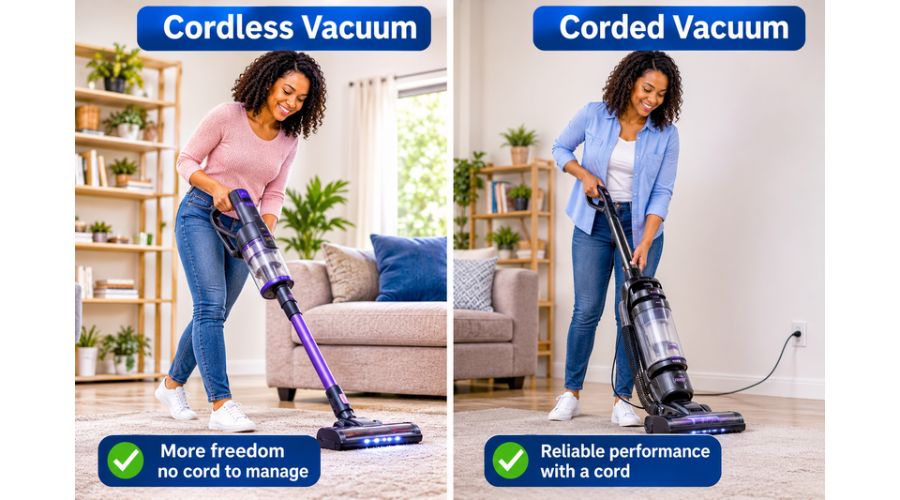
A cordless vacuum lets you move around without managing a power cable. At the same time, a corded model connects directly to an electrical outlet and can operate for as long as you need.
For most households, a cordless vacuum is the better choice for everyday cleaning because it is easier to maneuver, quick to grab, and convenient for cleaning different rooms, stairs, furniture, and even vehicles. You do not have to keep unplugging it or searching for another outlet as you move around.
However, corded vacuums still have important advantages, especially when you need extended cleaning sessions, consistent power, or a model that can handle large areas. The right choice ultimately depends on your home, cleaning habits, floor types, and budget.
Also Read:
What Is a Cordless Vacuum?
A cordless vacuum is a vacuum cleaner powered by a rechargeable battery rather than a power cable connected to a wall outlet. It uses an internal battery to operate its motor, generate suction, and collect dirt, dust, hair, and other debris.
Most cordless vacuums are designed for portability. They are commonly available as stick vacuums, handheld vacuums, and convertible models that switch from a full-length floor cleaner to a smaller handheld unit. Some also come with specialized attachments for cleaning upholstery, stairs, mattresses, curtains, and tight spaces.
Unlike a traditional corded vacuum, a cordless model doesn’t need to stay connected to an electrical outlet while cleaning. You can move from one room to another without worrying about the length of a power cable. This makes cordless vacuums particularly useful in homes with several rooms, stairs, and hard-to-reach cleaning areas.
However, cordless vacuum cleaners depend on battery capacity. Once the battery runs out, you must recharge it before continuing unless the model supports a removable spare battery. Runtime varies considerably depending on the model, battery size, suction setting, floor head, and attachments being used.
Advantages of Cordless Vacuums
Cordless vacuums have become increasingly popular because they address some of the inconveniences associated with traditional vacuum cleaners. Here are their main advantages.
Greater Freedom of Movement
One of the biggest advantages of a cordless vacuum is the freedom to clean without a power cable. You can move between rooms, reach corners, clean stairs, and vacuum furniture without repeatedly unplugging the machine.
This is especially helpful in larger homes where one outlet may not reach every cleaning area. Instead of stopping halfway through a room to find another outlet, you can continue cleaning wherever necessary.
You also do not have to worry about pulling a cable behind the vacuum, getting it caught under furniture, or accidentally running over it. This makes the entire cleaning process less frustrating.
Lightweight and Easy to Maneuver
Many cordless vacuum cleaners are lightweight and easy to handle. Their compact design suits people who don’t want to push around a bulky traditional vacuum.
A lightweight cordless stick vacuum is especially useful when cleaning stairs, ceilings, curtains, shelves, and other areas that require lifting the machine. Some models also feature swivel steering, allowing you to move around furniture legs and other obstacles without constantly changing direction.
If you have limited storage space, a compact cordless vacuum may also be easier to store than a large upright or canister vacuum.
Convenient for Quick Cleaning
You don’t always need a full house-cleaning session. Sometimes, you want to remove crumbs from the kitchen floor, pick up pet hair from the sofa, or clean a small mess near the entrance.
A cordless vacuum makes these quick cleaning tasks easier. You can pick it up, switch it on, clean the affected area, and return it to its charging station.
You don’t need to unwind a power cable, plug it into an outlet, and pack everything away afterward. This convenience encourages more frequent cleaning and helps prevent dust and debris from building up.
Suitable for Cleaning Stairs and Vehicles
Cleaning stairs with a traditional corded vacuum can be inconvenient because you have to manage the power cable while moving the machine between steps.
A cordless vacuum eliminates much of this difficulty. Handheld and convertible models are particularly useful because you can remove the main extension tube and use the smaller cleaning unit to reach individual steps.
The same advantage applies to vehicle interiors. You can carry a cordless vacuum into your garage or outside to clean car seats, floor mats, boot compartments, and other areas without searching for an outlet. However, runtime and suction performance will determine how much cleaning you can complete before recharging.
Modern Features and Versatile Attachments
Many cordless vacuums include features that make them useful for different cleaning tasks. Depending on the model, these may include adjustable suction levels, motorized brush heads, LED floor lights, removable batteries, wall-mounted charging stations, and digital battery displays.
Some models also include attachments such as crevice tools, upholstery brushes, and mini motorized heads for removing hair from furniture.
These accessories allow one vacuum to handle several cleaning jobs. For example, you can use the main floor head on carpets and hard floors, switch to a crevice tool for narrow gaps, and attach a smaller brush for cleaning sofas and car seats.
Easy Storage
Cordless vacuums are often more compact than traditional full-size corded models. Many stick vacuums can stand in a wall-mounted dock or a dedicated charging station, keeping them accessible without taking up much floor space.
This is especially useful in apartments, small houses, and homes with limited storage space.
Some models can also fold or convert into handheld units, making them easier to store in cupboards and other spaces.
No Power Cable to Manage
A power cable can be inconvenient when vacuuming around furniture, table legs, and other household objects. It may also get tangled or caught beneath the machine.
With a cordless vacuum, you avoid these problems entirely. You can move around freely without constantly checking the cable’s position.
This makes cleaning more straightforward, particularly in rooms with several pieces of furniture or narrow spaces.
Disadvantages of Cordless Vacuums
Although cordless vacuums offer excellent convenience, they are not perfect. Their battery-powered design introduces several limitations to consider before you buy one.
Limited Battery Runtime
The most obvious disadvantage of a cordless vacuum is that it cannot operate indefinitely. Its runtime depends on the amount of energy stored in its rechargeable battery.
Some models may provide enough operating time for quick cleaning, while others can handle more extensive sessions. However, the advertised maximum runtime often applies to the lowest suction setting and may not reflect real-world performance with motorized attachments or maximum power.
If you frequently clean a large house, you may find yourself recharging the vacuum before you finish. A model with a removable battery or an additional compatible battery can help reduce this inconvenience.
Charging time
Cordless vacuum cleaners need recharging after use. Depending on the battery and charging system, a full recharge can take several hours.
This means you cannot always continue cleaning immediately after the battery runs out. If you forget to charge the vacuum after using it, you may find it unavailable when you need it.
A charging dock makes the process easier because you can return the vacuum to its designated position after cleaning. Nevertheless, charging time remains an important consideration.
Battery Replacement Costs
Rechargeable batteries gradually lose their ability to hold a charge. After repeated charging and discharging cycles, you may notice your cordless vacuum runs for a shorter time than when it was new.
Eventually, you may need to replace the battery. The replacement cost depends on the manufacturer, battery capacity, model, and availability of compatible parts.
Some cordless vacuums have removable batteries, making replacement relatively straightforward. Others have batteries that are more difficult to access or are designed to be serviced by authorized technicians.
Before purchasing a cordless vacuum, check whether replacement batteries are available and how much they cost.
Performance May Vary With Battery Level and Power Settings
Cordless vacuum performance depends on its motor, battery, airflow design, and cleaning head. Some models may reduce power or change operating behavior when the battery is nearly depleted.
High-power modes also consume energy faster, reducing the time you can clean before recharging.
This means you may have to balance suction performance and battery life. If your home has thick carpets or significant pet hair, check independent performance tests rather than relying only on advertised suction figures.
Higher Initial Cost on Some Models
Cordless vacuum cleaners with advanced motors, larger batteries, specialized brush heads, and smart features can be expensive.
Although affordable options are available, some premium cordless models cost more than basic corded alternatives. You may also need to budget for replacement batteries and accessories over the machine’s life.
Therefore, compare overall value rather than choosing a vacuum based only on its appearance or advertised features.
What Is a Corded Vacuum?
A corded vacuum is a vacuum cleaner that receives electrical power directly from a wall outlet through a power cable. Unlike a cordless model, it doesn’t rely on a rechargeable battery.
Corded vacuums are available in several designs, including upright, canister, stick, and handheld models. People commonly use them in homes, offices, workshops, and other spaces that require extended cleaning sessions.
The main advantage of a corded vacuum is that it can run continuously while connected to a suitable power supply. You do not have to stop because the battery is empty or wait for the machine to recharge.
Many corded models also offer strong suction and suit cleaning large floor areas, carpets, and surfaces that require repeated passes. However, their mobility is limited by the power cable length and the location of electrical outlets.
Advantages of Corded Vacuums
Corded vacuums remain popular despite the growing availability of battery-powered alternatives. Their advantages make them suitable for households that prioritize uninterrupted cleaning and consistent electrical power.
Continuous Operation
One of the biggest benefits of a corded vacuum is that it can operate for extended periods without needing to recharge a battery.
As long as the vacuum stays connected to a working electrical outlet and you use it according to the manufacturer’s instructions, you can keep cleaning without worrying about battery runtime.
This is especially useful when vacuuming large houses, offices, carpets, and other areas that require lengthy cleaning sessions.
For example, if you are cleaning several rooms in one afternoon, you do not have to plan your work around the battery’s remaining charge. You can move from one area to another while managing the power cable.
Consistent Power Supply
A corded vacuum receives electrical power directly from the outlet rather than relying on stored battery energy.
This allows it to maintain its designed operating performance throughout a cleaning session, provided the electrical supply is stable and the machine is functioning correctly.
However, this does not mean every corded vacuum automatically has stronger suction than every cordless model. Actual cleaning performance depends on motor design, airflow, filtration, brush-roll performance, and overall engineering.
When comparing two models, look at their tested cleaning performance rather than assuming that the corded option is always more powerful.
Suitable for Large Homes
If you live in a large house, a corded vacuum may be more practical for extensive cleaning.
You do not need to stop and recharge after a limited operating period. You can clean several rooms, hallways, and carpets in one session.
A model with a long power cable can also cover a relatively large area before you need to move to another outlet.
This makes corded vacuums particularly useful for households that usually vacuum as one major cleaning activity rather than several short sessions.
No Battery Replacement Required
Corded vacuums do not rely on rechargeable batteries as their main power source. This eliminates the need to replace a vacuum battery after it loses capacity.
You may still need to replace filters, belts, brush rolls, or other components depending on the model, but you do not have to worry about battery degradation.
For buyers who prefer fewer battery-related expenses, this can be an important advantage.
Often More Affordable
Basic corded vacuum cleaners are often less expensive than premium cordless models.
If you have a limited budget, you may be able to purchase a capable corded vacuum without paying extra for a large rechargeable battery, charging dock, or advanced battery-management system.
This does not mean every corded vacuum is cheap. Premium upright and canister models can also cost a lot. However, corded designs generally offer more affordable options.
Suitable for Deep and Extended Cleaning
Some corded vacuums are designed for demanding cleaning tasks, including removing embedded dirt, dust, and pet hair from carpets.
Their continuous power supply makes them useful when you need to make several passes over a heavily soiled area.
Some models also have larger dust containers or bags, letting you clean longer before emptying them.
Nevertheless, deep-cleaning ability depends on the machine’s suction, airflow, brush design, height adjustment, and filtration system—not simply whether it has a cord.
Disadvantages of Corded Vacuums
Despite their ability to operate continuously, corded vacuum cleaners have limitations that can make them less convenient for everyday household cleaning.
Restricted Movement
The power cable is one of the biggest disadvantages of a corded vacuum.
You must remain within reach of an electrical outlet, which can restrict how far you can move while cleaning. If the cable isn’t long enough to reach another room, you will have to unplug the machine and plug it in somewhere else.
This can interrupt your cleaning routine, particularly in larger homes with several rooms and limited electrical outlets.
The cable can also become caught around furniture, doorways, and other obstacles.
Cable Management Can Be Frustrating
When using a corded vacuum, you must pay attention to where the power cable is positioned.
It may get tangled around furniture legs, trapped beneath the vacuum, or stretched across walkways. You also need to make sure the cable doesn’t interfere with the cleaning head.
Although some models include automatic cord rewind systems and cable hooks, you still have to manage the cable while vacuuming.
This makes corded models less convenient when moving quickly between different cleaning areas.
Less Convenient for Stairs and Vehicles
Cleaning stairs with a corded vacuum can be difficult, especially when using a bulky upright model.
You may need to position the machine on a landing or another stable surface while using an extension hose and attachments. The power cable can also limit how far you can reach.
The same problem applies to cleaning vehicles. Unless you have access to a suitable electrical outlet or an approved power source, using a corded household vacuum outside the home may be inconvenient.
A cordless handheld vacuum is generally easier to carry into a vehicle and use in tight spaces.
Bulky and Difficult to Store
Some corded vacuums, particularly traditional upright and canister models, are relatively large.
They may require more storage space than compact cordless stick vacuums. Their cables, hoses, and attachments can also make storage less convenient.
This may not be a serious issue if you have a dedicated cleaning cupboard. However, it can become frustrating in apartments and smaller homes where storage space is limited.
Requires Access to an Electrical Outlet
A corded vacuum cannot operate without a suitable electrical supply.
If you want to clean a garage, outdoor area, vehicle, or another location without convenient access to electricity, you may need an extension cord or a different vacuum.
Any extension cord must suit the appliance and be used according to the manufacturer’s safety instructions. Using an unsuitable cable can create electrical and overheating hazards.
Power Cable Can Create a Tripping Hazard
A corded vacuum’s power cable can stretch across walkways while you clean.
This may create a tripping hazard, particularly in busy households with children, older adults, or pets. You must watch the cable and keep it in a safe position.
A cordless vacuum avoids this problem because it has no trailing power cable.
Cordless vs. Corded Vacuum: Which Is Better?
Both cordless and corded vacuum cleaners can keep your home clean. However, they offer different experiences, and one may suit your needs better than the other.
For most people, a cordless vacuum is the better option for everyday household cleaning because of its portability, ease of use, and flexibility. You can quickly clean different rooms, reach stairs, remove pet hair from furniture, and vacuum your vehicle without managing a power cable.
A corded vacuum, on the other hand, may be the better choice if you regularly clean large areas, need uninterrupted operation, or prefer not to deal with rechargeable batteries.
Here is how the two compare across important buying factors.
Cleaning Performance and Suction Power
Cleaning performance is one of the most important factors when choosing a vacuum cleaner.
Corded vacuums have traditionally been associated with strong suction because they receive continuous electrical power from an outlet. Many are designed for extended cleaning sessions and can perform well on carpets, rugs, and hard floors.
However, modern cordless vacuums have improved significantly. Some premium battery-powered models deliver impressive suction and effective brush-roll performance, making them suitable for everyday household cleaning.
Suction power alone does not determine how well a vacuum cleans. Airflow, floor-head design, brush agitation, filtration, and the ability to maintain surface contact all influence the final result.
If you have thick carpets or several pets, compare tested carpet-cleaning and hair-removal performance before buying. Don’t assume a corded model will outperform every cordless alternative.
Winner: It depends on the specific models. Corded vacuums are often attractive for sustained cleaning, while high-quality cordless models can provide excellent everyday performance.
Battery Life and Runtime
Battery life is where cordless and corded vacuums differ most significantly.
A cordless vacuum can operate only as long as its battery has sufficient charge. Runtime varies with battery capacity, suction setting, floor type, and the accessories used.
For example, using a motorized brush head or maximum suction mode may reduce operating time compared with using a lower setting on a hard floor.
A corded vacuum has no such limitation. It can keep running while connected to a suitable electrical outlet, making it useful for longer cleaning sessions.
If you regularly clean a large house in one session, a corded vacuum may save you from interruptions caused by battery charging.
However, if you usually clean one or two rooms at a time, a good cordless vacuum’s runtime may be more than enough.
Winner: Corded vacuum, because it does not depend on battery runtime.
Portability and Ease of Use
A cordless vacuum is generally easier to move around because it has no power cable.
You can carry it upstairs, move between rooms, clean furniture, and reach tight spaces without unplugging it repeatedly.
Many cordless models are also lightweight and convertible so that you can use them as handheld cleaners.
A corded vacuum may be heavier and more difficult to maneuver, especially if it has a large body or a long hose. You must also make sure the cable does not get trapped or tangled while cleaning.
Although some corded stick vacuums are lightweight, the trailing cable remains an inconvenience.
Winner: Cordless vacuum.
Cost and Long-Term Value
A vacuum cleaner’s purchase price depends on its brand, features, design, and cleaning performance.
Basic corded vacuums are often more affordable than premium cordless models. They can be a good option if you want a functional machine without spending extra on rechargeable battery technology.
Cordless vacuums may cost more upfront, especially models with powerful motors, advanced filtration, removable batteries, and specialized attachments.
You should also consider long-term maintenance. A cordless vacuum may eventually need a replacement battery, while a corded model has no main operating battery to replace.
However, both types require routine maintenance, including cleaning filters, removing tangled hair, and replacing worn components.
Winner: Corded vacuum for buyers prioritizing a lower initial purchase price. Long-term value depends on the model’s durability and maintenance costs.
Cleaning Large Areas
If you regularly vacuum a large house, a corded vacuum can be a practical choice.
You can clean multiple rooms without worrying about the battery running out. A long cable may also allow you to cover several areas before changing outlets.
A cordless vacuum offers more flexibility but has a limited runtime. If the battery cannot last through your cleaning session, you may need to recharge or install a spare battery.
This does not mean cordless vacuums are unsuitable for large homes. Models with removable batteries and longer tested runtimes can handle substantial cleaning tasks.
Winner: Corded vacuum for lengthy cleaning sessions, although a high-capacity cordless model can also work well.
Cleaning Stairs, Furniture, and Vehicles
Cordless vacuums are particularly useful for cleaning areas that are difficult to reach with a traditional vacuum.
You can carry a cordless stick vacuum upstairs, convert it into a handheld cleaner, and use the appropriate attachment to remove dust and hair from furniture.
They are also convenient for cleaning car interiors because you do not need to position the vehicle near an electrical outlet.
Corded vacuums can perform these tasks too, especially models with long hoses and handheld attachments. However, managing the power cable and moving the machine around can make the process less convenient.
Winner: Cordless vacuum.
Maintenance and Durability
Both vacuum types require regular maintenance to maintain good cleaning performance.
Empty the dust container, clean washable filters according to the manufacturer’s instructions, remove hair from the brush roll, and check for blockages in the hose or air passages.
Cordless vacuums have an additional component to consider: the rechargeable battery. Its capacity gradually declines with use, and you may eventually need a replacement.
Corded vacuums avoid battery-related maintenance but can still develop problems involving their motors, switches, cables, belts, and other components.
A vacuum’s durability depends more on its construction, quality, maintenance, and availability of replacement parts than on whether it is cordless or corded.
Winner: Corded vacuum in terms of avoiding battery replacement. Overall durability depends on the specific model.
Noise Levels
Noise is another factor worth considering, especially if you vacuum early in the morning, late at night, or in a home with small children and pets.
Neither cordless nor corded vacuums are automatically quieter.
Noise levels depend on the motor, airflow design, brush roll, suction setting, and overall construction. Some cordless models run quietly at lower settings, while others get noticeably louder at maximum power.
Similarly, some corded vacuums have effective noise-reduction features, while others produce considerable sound during operation.
If noise is important to you, check the manufacturer’s noise rating where available and look for independent reviews that discuss real-world operating noise.
Winner: No universal winner. Compare the noise levels of the actual models.
Storage and Convenience
Cordless vacuums often have an advantage in storage.
Many stick models come with wall-mounted docks or compact charging stations. You can keep the vacuum in an accessible location and pick it up whenever you need to clean.
Corded vacuums may require more storage space, especially larger upright and canister models. You also need to store the power cable and any additional hoses or attachments.
However, cordless models must be stored with battery charging and manufacturer-recommended battery care in mind.
Winner: Cordless vacuum.
Cordless vs. Corded Vacuum Comparison Table
| Feature | Cordless Vacuum | Corded Vacuum |
|---|---|---|
| Power source | Rechargeable battery | Electrical outlet |
| Runtime | Limited by battery | Continuous while connected |
| Mobility | Excellent | Restricted by cable |
| Portability | Generally lightweight | Varies by design |
| Suction performance | Varies by model | Varies by model |
| Charging | Required | Not required |
| Battery replacement | May be required | Not applicable |
| Large cleaning sessions | Depends on battery | Generally convenient |
| Stair cleaning | Very convenient | Can be difficult |
| Vehicle cleaning | Convenient | Requires a suitable power source |
| Storage | Often compact | Can be bulky |
| Initial cost | Varies; premium models can be expensive | Often has affordable options |
| Cable management | Not required | Required |
Why a Cordless Vacuum Is Better for Most Homes
Although corded vacuums have several advantages, a cordless vacuum is the better choice for many modern households.
The main reason is convenience. Most people don’t vacuum for hours at a time. They usually clean specific rooms, remove visible dirt, pick up pet hair, or deal with small messes throughout the day.
A cordless vacuum makes these tasks easier because it is always accessible and does not require you to find an electrical outlet before cleaning.
Here are a few reasons to consider it.
It Makes Everyday Cleaning Easier
A cordless vacuum is designed to make cleaning less complicated.
You can pick it up from its charging station, switch it on, and clean the area that needs attention. You don’t have to unwind a power cable or move furniture to avoid getting it trapped.
This convenience is particularly valuable when you have a busy schedule and prefer to clean in short sessions.
It Reaches More Areas
Cordless vacuum cleaners allow you to clean areas that may be difficult to reach with a traditional corded model.
You can carry one upstairs, use it to clean a vehicle, or remove dust from furniture without worrying about nearby electrical outlets.
Convertible models offer even more flexibility because they can switch from a full-size stick vacuum to a handheld cleaner.
It Reduces Cable-Related Problems
A trailing power cable can make vacuuming frustrating.
You may have to move it around furniture, prevent it from getting caught under the cleaning head, or unplug the machine when moving into another room.
A cordless vacuum eliminates these inconveniences. You can focus on cleaning instead of managing the cable.
It Encourages Frequent Cleaning
One reason dirt accumulates in a home is that people sometimes postpone cleaning because getting the vacuum ready feels like too much work.
A cordless vacuum can make it easier to clean small messes as soon as they appear.
For example, you can quickly remove crumbs from the kitchen floor after preparing food or pick up pet hair from the sofa without setting up a full cleaning routine.
Frequent light cleaning can help keep your home looking tidy between more thorough cleaning sessions.
It Is Useful for Homes With Pets
Pet hair can accumulate on carpets, furniture, rugs, and other surfaces.
A cordless vacuum with a suitable motorized brush head can make it easier to remove this hair from different parts of your home.
You can also use smaller attachments to clean sofas, pet beds, and other areas where hair tends to collect.
However, if you have several pets or heavily carpeted rooms, check the vacuum’s tested hair-removal performance and battery runtime. A corded model may be more suitable if you need long cleaning sessions.
It Offers Greater Flexibility
A cordless vacuum can serve several purposes depending on its design and accessories.
You may use it to clean hard floors, carpets, stairs, upholstery, mattresses, and vehicle interiors.
Some models include removable batteries, multiple suction modes, and specialized attachments, making them more versatile.
This flexibility makes a cordless vacuum an attractive option if you want one machine for several everyday cleaning tasks.
How Does a Cordless Vacuum Work?
A cordless vacuum uses energy stored in a rechargeable battery to power an electric motor.
When you switch on the machine, the battery powers the motor. The motor drives a fan or impeller that creates a pressure difference, drawing air through the cleaning head and into the vacuum.
As air moves through the machine, it collects dust, hair, crumbs, and other debris in a dust container. Filters help capture fine particles before the air is released from the vacuum.
Most cordless vacuums have the following major components:
Rechargeable Battery
The battery stores the electrical energy needed to operate the vacuum. Many modern models use lithium-ion batteries because of their high energy density and rechargeability.
Battery capacity, voltage, and design influence how long the vacuum can operate. A larger battery may provide longer runtime, although actual performance also depends on motor efficiency and the selected power mode.
Electric Motor
The electric motor powers the vacuum’s airflow system. It drives the fan or impeller that creates suction.
Some models use brushless motors, which reduce friction from motor brushes and can operate more efficiently.
Cleaning Head
The cleaning head directs airflow toward the surface being cleaned.
Many cordless stick vacuums include a motorized brush roll that helps loosen dirt and hair from carpets. Other models use soft rollers or specialized heads designed for hard floors.
Dust Container
The dust container collects the dirt and debris removed from the floor.
Most cordless vacuums use bagless containers that you can detach and empty when full. Empty the container regularly to prevent reduced airflow and maintain cleaning performance.
Filtration System
The filtration system captures dust and other particles as air passes through the vacuum.
Some models use multiple filters, including fine-particle or HEPA filtration. If filtration performance is important, check the manufacturer’s specifications and whether the filters are properly sealed.
Charging System
After cleaning, recharge the battery.
Depending on the model, you may connect the charging cable directly to the vacuum or place it on a wall-mounted charging dock.
Some cordless vacuums have removable batteries, so you can charge a spare battery separately while using another.
How Does a Corded Vacuum Work?
A corded vacuum operates using electricity supplied directly from a wall outlet.
When you plug the vacuum into an electrical socket and switch it on, electricity flows through the power cable to the motor. The motor drives a fan or impeller, creating airflow that draws dust and debris into the machine.
The vacuum then separates and collects the debris while filters capture fine particles from the air.
Although corded vacuums come in different designs, most have several important components.
Power Cable
The power cable connects the vacuum to an electrical outlet.
It supplies the electricity needed to operate the motor and other electrical components. Cable length determines how far you can move the vacuum before needing to use another outlet.
Electric Motor
The motor drives the fan or impeller that creates the airflow required for suction.
Its performance depends on the motor design, electrical characteristics, and overall vacuum construction.
Fan or Impeller
The fan or impeller moves air through the vacuum, creating the pressure difference that draws dirt and debris into the machine.
As air enters through the cleaning head, particles travel through the internal air passages toward the dust container or collection bag.
Cleaning Head
The cleaning head contacts the floor and directs dirt toward the suction opening.
Some corded models have rotating brush rolls that loosen embedded debris from carpets, while others use simpler suction openings for hard floors.
Dust Bag or Container
Corded vacuums may use either disposable dust bags or reusable dust containers.
A bagged model stores dirt inside a replaceable bag, while a bagless model collects it in a removable container.
Empty or replace the collection system as the manufacturer recommends to maintain airflow.
Filters
Filters capture dust and other particles before air exits the vacuum.
Some models use washable filters, while others require periodic replacement. Always follow the manufacturer’s cleaning instructions, because washing a filter that isn’t designed to be washable can damage it.
The video below demonstrates a better choice for your home between the corded and cordless vacuum cleaner
Conclusion
The choice between a cordless and corded vacuum depends on how you clean your home and what you expect from your vacuum cleaner. Both options can deliver effective cleaning performance, but they have different strengths.
A cordless vacuum is the better choice for most everyday household cleaning because it offers greater freedom of movement, easy handling, convenient storage, and versatility. You can use it to clean floors, stairs, furniture, and vehicle interiors without dealing with a power cable. Its main limitations are battery runtime, charging time, and the eventual cost of replacing the battery.
A corded vacuum is worth considering if you regularly clean large areas, need uninterrupted operation, or want to avoid battery-related expenses. Although its cable restricts movement, it can be a dependable option for extended cleaning sessions.
Before purchasing either type, consider your home’s floor surfaces, cleaning habits, storage space, budget, and the availability of replacement parts. If convenience and portability matter most, choose a cordless vacuum with sufficient battery runtime and good cleaning performance. If uninterrupted operation is your priority, a corded vacuum may be the better investment.