
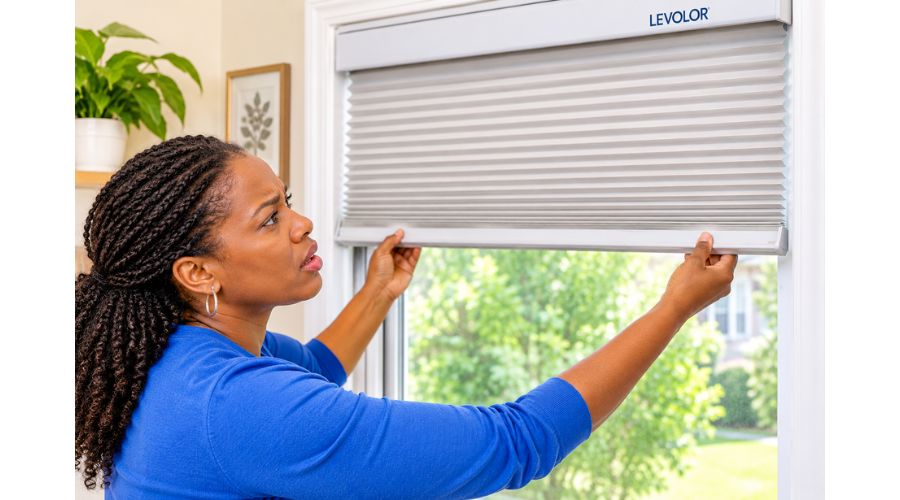
Window blinds do more than decorate a room. They help control natural light, provide privacy, and protect furniture and other household items from direct sunlight. Levolor cordless blinds are popular because they offer a clean appearance and eliminate dangling lift cords. Their simple design can make everyday operation convenient, but like other mechanical window treatments, they can sometimes develop problems.
One common complaint is that Levolor cordless blinds won’t go down. You may pull the bottom rail and find that the blind refuses to move, stops halfway, or lowers unevenly. In some cases, the blind may move a little and then spring back up. These symptoms can be frustrating, particularly when you need to block sunlight or restore privacy.
The cause is not always a broken spring. A cordless blind may resist lowering because it is locked in an uneven position, its internal lift mechanism is not engaging correctly, the bottom rail is obstructed, or a component has become worn or damaged. Motorized models can have different causes, including a power or control issue.
This guide explains how Levolor cordless blinds work, what may prevent them from lowering, and which troubleshooting steps you can try safely. It also explains when to stop and contact Levolor or a qualified blind-repair professional. Because Levolor makes different blind and shade styles, the correct procedure can vary by product. Always check the instructions for your specific model before attempting an adjustment.
Also Read:
How Do Levolor Cordless Blinds Work?
Cordless blinds are designed to raise and lower without a freely hanging lift cord. Instead, the lifting mechanism is built into the headrail or blind assembly. Depending on the model, the mechanism may use springs, internal cords, a clutch, or a motor.
When you lower a manually operated blind, you usually hold the bottom rail and guide it down. When you raise it, you lift the rail toward the headrail. Some products use a different operating method, so it is important to follow the instructions supplied with your blinds.
Manual cordless blinds
Manual cordless blinds are operated by hand. Many use a spring-assisted mechanism to help hold the blind at different heights. The bottom rail is the part you typically grasp when raising or lowering the blind.
If the blind is not level, is being pulled unevenly, or has a problem inside the headrail, it may resist movement. Avoid forcing it down, because excessive pressure can damage the lift mechanism or fabric.
Motorized cordless blinds
Motorized blinds use a motor to move the covering. Depending on the model, they may be operated with a remote, wall control, or compatible smart-home system.
If a motorized Levolor blind will not lower, the cause may be related to power, the control, a limit setting, or the motor itself. The manual troubleshooting steps for a spring-assisted blind may not apply to a motorized model.
Different blind and shade styles
Levolor offers different types of window coverings, and their internal mechanisms are not identical. Cellular shades, roller shades, wood blinds, and other styles may require different troubleshooting procedures.
Before attempting a repair, identify the product type and, if possible, locate its model information. A solution that works for one style may not be suitable for another.
Why Levolor Cordless Blinds May Not Go Down
If your Levolor blinds are stuck, begin with simple checks before assuming an internal part has failed. The following are common possibilities, although the exact cause depends on the product and its condition.
The bottom rail is not being guided evenly
If one side of the bottom rail is pulled farther down than the other, the blind may become uneven or bind. This can make it difficult to lower smoothly.
Try guiding the rail evenly with both hands. Do not jerk one side or pull hard on a single corner. If the blind remains crooked or stops moving, discontinue the attempt and inspect the visible parts for an obstruction.
Something is blocking the blind
A window latch, decorative item, furniture, or another object near the window may interfere with the blind’s movement. Even a small obstruction can prevent the bottom rail from traveling freely.
Check the area around the window and along the path of the blind. Remove any obstruction you can reach safely without forcing the blind or bending its slats.
The blind is caught or uneven inside the headrail
The headrail contains the components that support the blind and control its movement. If the blind is pulled unevenly or has been handled roughly, part of the mechanism may not move as intended.
Do not open the headrail immediately. First try the manufacturer’s recommended operating method and check whether the blind is level. If it remains stuck, the internal mechanism may need professional attention.
The spring or lift mechanism may be worn
Some manual cordless blinds use a spring-assisted lift mechanism. If the mechanism becomes worn, loses tension, or fails to engage, the blind may not lower or stay in position.
A spring problem is one possible explanation, but it should not be assumed without checking other causes. Springs and other internal components can be under tension, so do not dismantle them unless the product instructions specifically authorize the procedure.
The blind may need a model-specific adjustment
Some cordless products have a prescribed procedure for correcting uneven movement or restoring normal operation. The correct steps depend on the model.
If the blind has recently been installed, check the installation and operating instructions. If it has worked for a long time and has suddenly stopped, look for an obstruction or visible damage before attempting any adjustment.
A motorized blind may have a power or control issue
For motorized models, a failed or depleted power source, an unresponsive remote, or a control problem may prevent the blind from moving.
Check the power source and control according to the manufacturer’s instructions. Do not apply the manual blind’s operating method to a motorized model unless its instructions say to do so.
How to Troubleshoot Levolor Cordless Blinds That Won’t Go Down
The following checks are intended for basic troubleshooting. They do not require opening the headrail or handling internal springs, wiring, or other components.
1. Identify the type of blind
Start by determining whether your Levolor window covering is manual or motorized. Then identify its style, such as cellular, roller, or horizontal blinds.
This matters because the operating method and repair instructions can differ. If you are unsure which product you have, look for a label, order information, or installation guide.
2. Check for visible obstructions
Look along the sides of the blind and around the window frame. Check whether the bottom rail is caught on a latch, sill, furniture, or another object.
Remove any obstruction that is easy to reach. Do not pull the blind forcefully past an object or try to bend the rail to make it fit.
3. Make sure the blind is level
If the bottom rail is tilted, the blind may be binding. Hold the rail with both hands and check whether one side is lower than the other.
If the product instructions allow it, guide the rail gently and evenly. Stop if it resists, becomes more uneven, or makes an unusual sound. Repeated force can worsen the problem.
4. Use the normal operating method
For a manual blind, follow the operating instructions provided with that model. Use the bottom rail or designated control rather than pulling on the fabric, slats, or internal cords.
If the blind moves only a short distance, do not repeatedly tug on it. The mechanism may be obstructed or damaged.
5. Check the installation
A blind that was recently installed may not be seated correctly in its brackets or may be obstructed by the window frame. Review the installation instructions and look for obvious misalignment.
Do not remove the blind from its brackets unless the instructions explain how to do so safely. Some components may be under tension, and an incorrectly reinstalled blind can fall or operate poorly.
6. Check the power and control on motorized models
If the blind is motorized, check the power source, remote, or control system as directed by the manufacturer. Replace or recharge batteries only as specified.
If the control responds but the blind does not move, or if the motor makes an unusual sound, stop operating it and consult the model’s troubleshooting instructions.
7. Stop if the blind remains stuck
If the blind will not lower after these basic checks, do not force it. A damaged lift mechanism, internal cord, spring, motor, or other component may need service.
Contact Levolor support or a qualified window-covering repair professional. Provide the product type, model information, and a description of what happens when you try to lower it.
What If the Blind Is Stuck Halfway?
A cordless blind stuck halfway may be experiencing a different issue from one that will not move at all. It may lower partway and then stop, rise back up, or hang unevenly.
First, check whether the bottom rail is level and whether anything is blocking its path. If the blind is manual, use the normal operating method described in its instructions. Avoid pulling one side down farther than the other.
If the blind repeatedly stops at the same point, the mechanism may be catching or a component may be damaged. Do not continue cycling it in the hope that the problem will disappear. Repeated force can strain the internal parts.
For a motorized blind, a limit or control issue may be involved. Use only the reset or limit-setting procedure specified for that exact model. Do not assume that all Levolor motorized blinds use the same reset sequence.
What If Levolor Cordless Blinds Won’t Stay Down?
Sometimes the blind can be lowered but will not remain at the selected height. It may rise on its own, drift upward, or refuse to stay in place.
On a manual blind, this may indicate that the lift mechanism is not holding the blind as intended. It can also happen when the blind is not being operated according to its instructions or when an internal component is worn.
Try the recommended operating method once, making sure the rail is level. If the blind still rises or slips, stop and consult the product manual or a repair professional. Do not attempt to tighten or alter a spring mechanism without model-specific instructions.
For a motorized blind, check whether the problem is related to the control settings or power. If it continues, contact the manufacturer or a qualified technician.
Can You Repair Levolor Cordless Blinds Yourself?
Some problems are suitable for simple troubleshooting, while others require professional repair. The safest approach is to distinguish between an external issue and a fault inside the blind.
Repairs you may be able to handle
Depending on the product and its instructions, you may be able to:
- Remove an obstruction near the blind
- Check whether the bottom rail is level
- Confirm that the blind is being operated correctly
- Check the power source on a motorized model
- Review the installation and operating instructions
- Contact support with the model details and symptoms
These steps can help identify a straightforward issue without exposing internal components.
Repairs that may require professional help
A qualified repair professional may be needed if the blind has a damaged spring, broken lift component, internal cord problem, damaged headrail, or motor fault.
Avoid opening the headrail or removing internal parts unless the manufacturer’s instructions explicitly describe the procedure for your model. Some mechanisms contain stored tension, and incorrect handling can cause injury or further damage.
Why You Should Avoid Forcing a Stuck Blind
It may seem reasonable to pull harder when a blind refuses to lower, but force can make the problem worse. The bottom rail, fabric, slats, internal cords, and lift mechanism are designed to move in a particular way.
Excessive pulling may:
- Bend or damage the bottom rail
- Cause the blind to become uneven
- Strain internal cords or lift components
- Damage the spring-assisted mechanism
- Pull the blind out of its mounting brackets
- Make a repair more complicated or expensive
If the blind does not respond to gentle, correct operation, stop and investigate the cause rather than applying more force.
How to Care for Levolor Cordless Blinds
Regular care can help keep your blinds operating smoothly and may reduce the chance of avoidable problems.
Operate the blind gently
Use the designated rail or control and follow the manufacturer’s operating instructions. Avoid sudden pulls, twisting, or lifting one side much farther than the other.
Keep the window area clear
Make sure furniture, decorations, window locks, and other objects do not obstruct the blind’s path. Check the area occasionally, especially if the room layout changes.
Clean according to the product instructions
Different materials require different cleaning methods. Use the cleaning guidance for your specific Levolor blind or shade. Avoid soaking components or applying cleaning products that may damage the fabric, finish, or mechanism.
Inspect for visible damage
Occasionally look for a bent rail, damaged slats, loose mounting hardware, or other visible changes. If you notice a problem, stop operating the blind until you know whether it is safe to continue.
Keep the instructions and model information
Save the product manual, model number, and purchase information. These details can make it easier to find the correct troubleshooting steps or obtain replacement parts and service.
When to Contact Levolor or a Blind Repair Professional
Contact Levolor support or a qualified repair professional if:
- The blind remains stuck after basic checks
- The bottom rail is badly uneven
- The blind makes unusual noises
- A visible component is broken or damaged
- The blind will not stay at the selected height
- A motorized blind does not respond to its control
- The product needs internal repair or disassembly
When requesting help, explain whether the blind is manual or motorized, identify its style, and describe exactly what happens when you try to lower it. If possible, provide the model number and a photo of the blind’s overall appearance and any visible damage.
This information can help the service provider determine whether the issue may be resolved through model-specific troubleshooting or whether the blind needs repair.
Frequently Asked Questions
Why won’t my Levolor cordless blinds go down?
Possible causes include an obstruction, an uneven bottom rail, incorrect operation, or a problem with the internal lift mechanism. Motorized blinds may also have a power or control issue. Start with basic checks and consult the instructions for your exact model.
How do I fix Levolor cordless blinds that are stuck?
Check for obstructions, make sure the bottom rail is level, and operate the blind according to its instructions. Do not force it or open the headrail without model-specific guidance. If it remains stuck, contact Levolor or a qualified repair professional.
Why do my cordless blinds go down but then rise back up?
The lift mechanism may not be holding the blind as intended, or the blind may be operated unevenly. On motorized models, a control or setting issue may be involved. Check the product instructions and stop if the problem continues.
Can I repair the spring in my Levolor cordless blinds?
Some spring-related problems may be repairable, but the correct procedure depends on the product. Internal mechanisms can contain tension, so do not dismantle or adjust a spring unless the manufacturer’s instructions specifically authorize the work. A qualified repair professional can assess the mechanism.
Should I pull harder if my Levolor blinds are stuck?
No. Pulling harder can damage the rail, internal cords, or lift mechanism and may pull the blind out of its brackets. Use gentle, even movement and stop if the blind resists.
Do motorized Levolor blinds use the same troubleshooting steps?
Not always. Motorized blinds may require checks involving the power source, remote, control system, or model-specific settings. Follow the instructions for the exact product rather than applying manual-blind procedures.
Can I remove the blind from the window to repair it?
Only do so if the manufacturer’s instructions explain how to remove and reinstall your model safely. If the blind is stuck or has a damaged mechanism, a professional may be better equipped to handle it without causing further damage.
Conclusion
When Levolor cordless blinds won’t go down, the cause may be something simple, such as an obstruction or uneven bottom rail. It may also involve the lift mechanism, a damaged component, or—on motorized models—a power or control issue.
Start with the basic checks: identify the blind type, inspect the area for obstructions, make sure the rail is level, and follow the correct operating method. Avoid forcing the blind or dismantling internal parts without model-specific instructions. If it remains stuck, contact Levolor or a qualified repair professional.
With careful troubleshooting and proper operation, you can often identify the source of the problem and choose the safest way to restore your blind’s normal movement.