Choosing a cordless pressure washer is not just about finding a model with the highest pressure rating. You need enough cleaning power to remove dirt, mud, grime, and other stubborn deposits without damaging the surface you are cleaning.
This is why understanding what PSI you need in a cordless pressure washer is important before making a purchase. A pressure washer designed for rinsing a vehicle may not have enough power to clean a heavily stained concrete driveway.
In contrast, a machine with excessive pressure can damage car paint, wooden decking, and outdoor furniture.
Most cordless pressure washers are designed for portability and everyday cleaning rather than demanding commercial applications. Depending on the model, they may provide anything from a few hundred PSI to more than 2,000 PSI.
However, the actual cleaning performance also depends on water flow rate, nozzle selection, battery capacity, and the design of the pump.
Read on as we explore the appropriate PSI for your washing job.
Also Read:
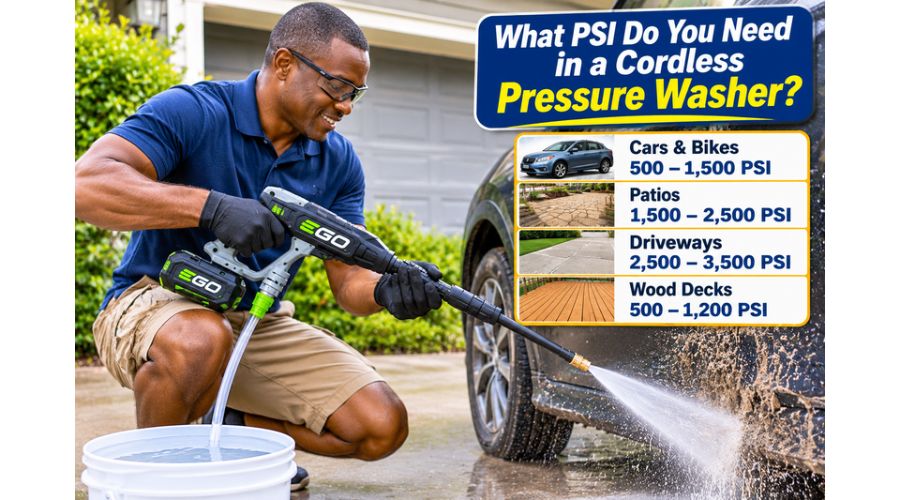
What PSI Do You Need in a Cordless Pressure Washer?
The PSI you need depends on the type of surface you want to clean and how much dirt you need to remove. PSI stands for pounds per square inch and measures the pressure produced by the machine.
A higher PSI generally means a stronger water stream, but it does not automatically mean faster or better cleaning.
For most everyday household cleaning tasks, a cordless pressure washer producing approximately 500 to 2,000 PSI can be useful. Lower-pressure models are suitable for rinsing vehicles, cleaning outdoor furniture, and removing loose dirt. More powerful models can handle tougher jobs, provided their water flow rate and accessories are suitable.
Here is a general guide to the pressure levels you may need for different applications:
| Cleaning task | General pressure range |
|---|---|
| Rinsing cars and motorcycles | 500–1,500 PSI |
| Cleaning outdoor furniture | 500–1,500 PSI |
| Washing bicycles and garden equipment | 500–1,500 PSI |
| Cleaning windows and delicate surfaces | Low pressure with a wide spray |
| Washing fences and wooden surfaces | 500–1,200 PSI to start |
| Cleaning vinyl siding | Approximately 1,000–1,600 PSI, where permitted |
| Cleaning patios and paved surfaces | 1,500–2,500 PSI, depending on the material |
| Cleaning concrete driveways | Approximately 2,500–3,500 PSI for demanding jobs |
These figures are general starting points rather than universal manufacturer recommendations. The safest pressure for a particular surface depends on its condition, material, age, nozzle, spray distance, and the manufacturer’s cleaning instructions. For delicate surfaces, always begin with the lowest effective setting.
You should also understand that many compact cordless pressure washers do not reach the higher pressure levels required for demanding concrete cleaning. A portable model advertised at 800 or 1,200 PSI can be useful for washing a car, rinsing outdoor equipment, and cleaning light dirt, but it should not be expected to perform like a full-size 3,000 PSI pressure washer.
If you intend to clean several different surfaces, choose a cordless pressure washer with adjustable pressure settings and interchangeable nozzles. This gives you more control over the water stream and makes it easier to move between light and moderately demanding jobs.
What Does PSI Mean on a Cordless Pressure Washer?
PSI is one of the most important specifications to check when shopping for a pressure washer. It tells you how much pressure the machine can produce and helps you understand the force of the water leaving the spray nozzle.
For example, a cordless pressure washer rated at 800 PSI produces a less forceful stream than a model rated at 1,500 PSI, assuming the figures are measured under comparable conditions.
The higher-pressure machine may remove more stubborn dirt, but the result also depends on how much water it delivers and which nozzle you use.
Understanding Pounds per Square Inch
The term PSI means pounds per square inch. It describes the pressure exerted over a particular area.
In a pressure washer, the pump increases the pressure of the water before sending it through the hose and spray gun. The nozzle then shapes the water into a particular spray pattern.
A narrow nozzle concentrates the water into a smaller area, creating a more focused stream. A wider nozzle spreads the water over a larger area, reducing the concentration of force on one spot.
This explains why two pressure washers with the same PSI rating can produce different cleaning results when fitted with different nozzles.
Why Higher PSI Is Not Always Better
It is tempting to assume that the cordless pressure washer with the highest PSI is automatically the best. However, excessive pressure can damage surfaces and make certain cleaning jobs more difficult.
For example, using a concentrated high-pressure stream on a vehicle may damage paint, force water into seals, or harm delicate trim. On wooden decking, excessive pressure can strip away the surface, raise the wood grain, or leave visible marks.
The same problem can occur when cleaning exterior walls, window frames, and outdoor furniture. Some materials require a gentle spray rather than a powerful jet.
The best approach is to select a pressure washer that provides enough cleaning power for your regular tasks without exposing delicate surfaces to unnecessary force.
Maximum PSI vs. Working PSI
Another important consideration is the difference between maximum advertised PSI and the pressure delivered during normal operation.
Some manufacturers advertise the highest pressure a machine can briefly produce under particular conditions. This figure may not represent the pressure available during continuous cleaning.
When comparing cordless pressure washers, check whether the manufacturer provides a rated operating pressure, working pressure, or maximum pressure. If only a maximum figure is available, avoid assuming that the machine will maintain that pressure throughout the cleaning session.
This distinction is particularly important when comparing compact battery-powered cleaners with full-size electric or gas pressure washers.
Before buying, read the product specifications and operating manual carefully. A clearly stated working pressure is more useful than relying on an impressive headline number alone.
What PSI Do You Need to Wash a Car With a Cordless Pressure Washer?
For washing cars, you generally do not need an extremely powerful pressure washer. A moderate-pressure cordless model can remove loose dirt, road dust, and mud while providing the convenience of portable operation.
A broad range of approximately 500 to 1,500 PSI can be suitable for many vehicle-rinsing tasks, provided you use an appropriate nozzle and maintain a safe distance. Some conventional pressure washer guides recommend higher ranges for vehicle cleaning, but the actual safe setting depends on the vehicle, nozzle, and equipment.
Why You Should Avoid Excessive Pressure on Car Paint
Your vehicle’s exterior has several surfaces that require careful cleaning. These include painted panels, plastic trim, rubber seals, headlights, mirrors, and delicate badges.
A concentrated stream directed too closely at these components can cause damage. It may lift loose paint, worsen existing chips, damage weather seals, or force water into areas that should remain dry.
This is why you should not use the highest pressure setting simply because your cordless pressure washer offers it.
Start with a wide spray pattern and a low setting. Test the water stream on a less visible area before washing the entire vehicle.
Choose the Right Nozzle for Car Washing
The nozzle determines how the water is distributed across the vehicle’s surface.
A 40-degree nozzle generally produces a wider spray that is useful for rinsing loose dirt from painted panels. A 25-degree nozzle may provide more cleaning force, but you should use it cautiously and maintain an appropriate distance.
Avoid using a zero-degree nozzle on vehicle paint. Its concentrated stream can damage the finish, particularly when directed at close range.
If your cordless pressure washer includes a foam bottle, you can apply a suitable car shampoo before rinsing. Allow the cleaning solution to work according to its instructions, then rinse it away using a gentle, even spray.
How to Wash a Car Safely
Follow these basic steps when using a cordless pressure washer to clean your vehicle:
- Park the vehicle in a suitable shaded area and allow hot surfaces to cool.
- Connect the pressure washer to its battery and water source according to the manufacturer’s instructions.
- Select a wide-angle nozzle and the lowest effective pressure setting.
- Rinse loose dirt from the vehicle, working from the top downward.
- Apply a vehicle-safe cleaning solution if your equipment supports detergent application.
- Wash the vehicle using a suitable wash mitt and car shampoo.
- Rinse the soap away using a broad, controlled spray.
- Dry the vehicle with a clean microfiber towel.
Remember that a pressure washer does not replace proper hand washing. It helps rinse loose dirt and cleaning products, but using a suitable wash mitt is still important when removing bonded grime.
What PSI Do You Need to Clean a Driveway?
Cleaning a concrete driveway requires considerably more pressure than rinsing a car or washing outdoor furniture. Concrete is a hard surface that can accumulate mud, algae, tire marks, oil stains, and embedded dirt.
For many demanding driveway-cleaning jobs, a pressure washer producing approximately 2,500 to 3,500 PSI is commonly recommended. Some lighter cleaning tasks can be completed with less pressure, but the time and effort required may increase.
This is where many cordless pressure washers have limitations. Compact battery-powered models are often designed for portable household cleaning rather than restoring large concrete surfaces.
Can a Cordless Pressure Washer Clean Concrete?
Yes, a cordless pressure washer can clean concrete, but its effectiveness depends on its pressure, water flow rate, and the condition of the surface.
A model producing around 1,000 to 1,500 PSI may remove loose dirt, dust, and light surface grime from a small paved area.
However, it may struggle with deeply embedded dirt, old oil stains, or heavily soiled concrete.
A more powerful battery-powered model may handle moderate cleaning, but you should compare its actual working pressure and water flow with the demands of the job.
If you regularly clean a large driveway, a full-size electric or gas pressure washer may be a better investment.
Why Water Flow Matters When Cleaning Driveways
PSI is important, but it is not the only specification that determines cleaning performance.
Water flow rate, measured in gallons per minute (GPM), tells you how much water the pressure washer delivers. A higher flow rate can help rinse away loosened dirt more quickly and cover larger areas.
For example, two pressure washers may produce similar pressure, but the one delivering more water may complete a cleaning task faster, depending on their nozzle designs and operating conditions.
This is why you should compare both PSI and GPM rather than choosing a machine based on pressure alone.
When a Cordless Model Is Not Enough
A small cordless pressure washer is not necessarily the best tool for removing years of dirt from a large driveway.
If the concrete has deep oil stains, heavy algae growth, or stubborn tire marks, you may need a more powerful pressure washer, a suitable detergent, and a surface-cleaning attachment.
A surface cleaner distributes water across a wider area and can help produce a more consistent finish than using a single spray lance.
For demanding driveway work, consider a full-size machine with suitable pressure and flow specifications. Do not force a small cordless cleaner to perform a job beyond its intended capabilities.
What PSI Do You Need for Wooden Decks and Fences?
Wood is more vulnerable to pressure damage than concrete. Even when a wooden deck looks strong, excessive water pressure can strip away the surface, damage the grain, and leave permanent marks.
For this reason, you should start with a low-pressure setting when cleaning wooden decks and fences.
A general starting range of approximately 500 to 1,200 PSI may be suitable for some wood-cleaning applications, but the manufacturer’s guidance for the specific wood and equipment should take priority.
Why Wood Requires Lower Pressure
Unlike concrete, wood has a softer and more absorbent surface. The force of a concentrated water stream can cut into the grain and leave grooves.
Softwood varieties such as pine and cedar are particularly vulnerable. Older boards, damaged timber, and surfaces with peeling paint may also require extra care.
If you use too much pressure, you may create rough patches that require sanding before the wood can be stained or sealed again.
Use a Wide-Angle Nozzle
A wide-angle nozzle spreads the water over a larger area and reduces the concentration of force.
A 40-degree nozzle is a useful starting point for many gentle cleaning tasks. A 25-degree nozzle may be appropriate for some stronger surfaces, but you should test it carefully before proceeding.
Avoid using a zero-degree nozzle or a turbo nozzle on delicate wood unless the equipment and surface manufacturer specifically permit it.
Clean Along the Grain
When pressure washing a wooden deck or fence, move the spray in the direction of the wood grain.
Keep the nozzle moving rather than holding it over one spot. Begin at a greater distance and gradually move closer only if the surface can tolerate the spray.
Always test a small, hidden section first. Allow it to dry and inspect the result before cleaning the entire surface.
If the wood is particularly old, soft, or damaged, consider using a suitable deck-cleaning solution and a soft brush instead of relying on pressure alone.
What PSI Do You Need to Clean Outdoor Furniture?
Outdoor furniture is another common application for a cordless pressure washer. Garden chairs, tables, benches, and plastic furniture can accumulate dust, bird droppings, pollen, mud, and mildew.
For many outdoor furniture cleaning tasks, a low to moderate pressure setting is sufficient. A range of approximately 500 to 1,500 PSI can be useful, although delicate materials may require substantially less pressure.
Cleaning Plastic Furniture
Plastic chairs and tables are generally easier to clean than many other outdoor materials. A wide spray pattern can remove loose dirt and surface grime without requiring a highly concentrated stream.
Start with a low setting and increase the pressure only when necessary. Pay attention to joints, seams, and older plastic components because excessive pressure may damage weakened areas.
Cleaning Metal Furniture
Metal outdoor furniture can usually tolerate more cleaning pressure than delicate plastic or fabric, but the condition of its finish matters.
Painted, coated, or rusted metal may be damaged by a strong concentrated stream. Keep the nozzle at a safe distance and avoid directing the spray at loose paint or damaged protective coatings.
For stubborn grime, use a suitable cleaning product before rinsing.
Cleaning Cushions and Fabric
Be especially careful when cleaning outdoor cushions and fabric furniture. High-pressure water can damage stitching, force dirt deeper into some materials, or affect protective coatings.
Use a gentle spray only if the fabric manufacturer’s care instructions allow pressure washing. In many cases, hand cleaning with an appropriate fabric solution is the safer option.
What PSI Do You Need for Cleaning Vinyl Siding?
Vinyl siding can collect dust, pollen, spider webs, mud, and mildew. A pressure washer can make cleaning easier, but using too much pressure or spraying from the wrong direction can cause damage.
A general range of approximately 1,000 to 1,600 PSI may be suitable for some vinyl siding applications. However, always check the siding manufacturer’s cleaning recommendations and the pressure washer manual.
Why You Should Use Moderate Pressure
Vinyl siding is not designed to withstand unlimited water pressure. A powerful stream directed too closely may crack weakened panels or force water behind the siding.
Water entering behind the panels can contribute to moisture problems, particularly if it reaches insulation, sheathing, or other vulnerable building materials.
Use a broad spray pattern and keep the nozzle at a suitable distance from the wall.
Spray in the Correct Direction
When cleaning horizontal siding, direct the water downward rather than spraying upward beneath the panel edges.
Spraying upward can force water behind the siding, increasing the risk of moisture intrusion.
Work in manageable sections and avoid directing the spray at electrical fixtures, vents, damaged areas, or openings around windows and doors.
Use Cleaning Solutions Carefully
Some dirt and mildew may not come off easily with water alone. A siding-safe cleaning solution can help loosen deposits before rinsing.
Use only products approved for your siding and pressure washer. Follow the label instructions and protect nearby plants, electrical components, and other surfaces as necessary.
If the siding is old, cracked, or damaged, consider a gentler cleaning method.
How PSI, GPM, and Cleaning Units Work Together
When comparing cordless pressure washers, it is important to understand that PSI does not tell you everything about the machine’s cleaning performance.
Water pressure and water flow work together. A pressure washer needs sufficient pressure to loosen dirt and enough water volume to carry the loosened material away.
What Is GPM?
GPM stands for gallons per minute. It measures the amount of water the pressure washer delivers in one minute.
A pressure washer with a higher GPM can deliver more water to the cleaning surface. This can improve rinsing and help you cover larger areas more quickly.
For example, a compact cordless cleaner may have a relatively high advertised PSI but a low water flow rate. It can produce a forceful stream, yet take longer to rinse a large surface.
This is one reason portable pressure washers should not be compared with full-size machines using PSI alone.
What Are Cleaning Units?
Cleaning units are a simple way of combining PSI and GPM to compare pressure washer output.
The basic calculation is:
Cleaning units = PSI × GPM
For example, a pressure washer delivering 1,000 PSI at 1.0 GPM has 1,000 cleaning units.
Another machine delivering 1,500 PSI at 0.8 GPM has 1,200 cleaning units.
This calculation can provide a useful comparison, but it does not account for every factor affecting real-world performance. Nozzle design, pump efficiency, water temperature, detergent, and cleaning technique also matter.
Why This Matters When Buying a Cordless Pressure Washer
Battery-powered pressure washers often have lower water flow rates than larger electric and gas-powered models.
This is partly because compact battery-powered designs must balance performance, motor demand, battery capacity, weight, and runtime.
When comparing products, look for both the rated PSI and GPM. If the manufacturer does not provide a flow rate, avoid assuming that a high PSI figure guarantees strong overall cleaning performance.
You should also check whether the stated figures are maximum or rated operating values.
How to Choose the Right PSI for Your Cleaning Needs
Before buying a cordless pressure washer, identify the surfaces you intend to clean most often. This will help you avoid purchasing a machine that is either underpowered for your work or unnecessarily powerful for your needs.
Here are the main factors to consider.
Identify Your Most Common Cleaning Tasks
Start by listing the jobs you expect the pressure washer to handle.
If you mainly wash cars, motorcycles, bicycles, and outdoor furniture, you probably do not need a high-pressure machine designed for concrete cleaning.
However, if you regularly clean patios, paved walkways, and heavily soiled outdoor surfaces, you may need a more powerful model.
Do not buy a pressure washer based on an occasional job if most of your cleaning involves lighter tasks. Choose a machine that suits your regular needs.
Consider the Surface Material
Different surfaces tolerate different levels of water pressure.
Concrete is generally more durable than wood, plastic, painted metal, or vehicle paint. A pressure level that works well on concrete may damage a softer material.
Consider the age and condition of the surface as well. Old paint, cracked plastic, deteriorating wood, and damaged seals may be more vulnerable than new materials.
When uncertain, start with a low setting and test a hidden area.
Look for Adjustable Pressure Settings
A cordless pressure washer with adjustable pressure settings gives you greater flexibility.
You can use a lower setting for delicate surfaces and increase the pressure when cleaning more durable materials.
Some portable models provide two or three operating modes. Others allow you to adjust pressure through a control panel or trigger system.
Adjustability is particularly useful if you intend to clean vehicles, furniture, fences, and paved areas with the same machine.
Check the Nozzle Options
The nozzle determines the spray pattern and affects how concentrated the water stream is.
Many cordless pressure washers include multi-pattern nozzles that provide several spray angles. These can be useful when moving between different cleaning tasks.
A wide spray is generally preferable for delicate surfaces, while a narrower spray may be useful for tougher dirt on durable materials.
However, a narrow nozzle should not be used indiscriminately. Always match the nozzle to the surface and follow the manufacturer’s instructions.
Consider Battery Capacity and Runtime
PSI is only useful if the pressure washer can operate long enough to complete your cleaning task.
Battery capacity is commonly measured in amp-hours (Ah) or watt-hours (Wh). A larger battery may provide longer runtime, although actual performance depends on the motor, pump, operating mode, and battery condition.
High-pressure settings can consume more battery power than lower settings. If you plan to clean several vehicles or a large outdoor area, consider a model with a larger compatible battery or the option to use a spare battery.
Check whether the battery and charger are included. Some cordless pressure washers are sold as tool-only products, meaning you must purchase a compatible battery separately.
Check Water Flow and Water Supply Options
A cordless pressure washer may connect to a garden hose or draw water from a suitable container using a suction hose and filter.
The water source can affect how conveniently you use the machine. A model that draws water from a bucket may be useful when washing a vehicle away from an outdoor tap.
However, suction capability does not mean that the machine can draw water from every source under every condition. Check the manufacturer’s instructions for maximum suction height, hose requirements, filter installation, and approved water sources.
Always use clean water and keep the filter properly installed to protect the pump.
Compare the Actual Specifications
Before purchasing, compare the manufacturer’s rated pressure, maximum pressure, water flow, battery requirements, runtime, and included accessories.
Do not rely exclusively on product titles or promotional descriptions. Some compact power cleaners advertise impressive maximum PSI figures without clearly stating their normal operating pressure or water flow.
A product with transparent specifications is easier to evaluate and compare with competing models.
What Are the Limitations of Cordless Pressure Washers?
Cordless pressure washers offer convenience, but they have limitations that you should understand before purchasing one.
Their main advantage is portability. You do not have to connect the machine to an electrical outlet, and some models can draw water from a suitable container.
However, their compact design and reliance on batteries can limit their performance compared with larger pressure washers.
Lower Cleaning Power on Some Models
Many portable cordless pressure washers are designed for light household cleaning. They may not have enough pressure or water flow to remove deeply embedded dirt from concrete, strip stubborn stains, or clean large paved areas efficiently.
If your main purpose is heavy-duty cleaning, compare full-size electric or gas-powered machines as well.
Limited Battery Runtime
Battery-powered equipment cannot operate indefinitely without recharging or replacing the battery.
Runtime depends on battery capacity, pressure setting, motor efficiency, pump design, and how frequently you use the trigger.
Some manufacturers advertise runtime figures under particular operating conditions. Treat these as estimates rather than guarantees.
For longer cleaning sessions, consider a model with a removable battery and an additional compatible battery.
Water Flow May Be Lower
Compact cordless pressure washers often deliver less water than larger machines.
This can make them slower when cleaning large surfaces because they may take longer to rinse away loosened dirt.
A machine with adequate PSI but limited GPM may still be useful for small cleaning tasks, but it may not be the best choice for large areas.
Not Every Model Handles Large Windows or Heavy Dirt
A cordless pressure washer’s suitability depends on its design and specifications.
Some models are handheld power cleaners intended for rinsing and light cleaning. Others are larger battery-powered units capable of handling more demanding household applications.
Do not assume that all cordless pressure washers provide the same performance. Check the product’s intended use and manufacturer specifications before buying.
Common Mistakes to Avoid When Choosing a Cordless Pressure Washer
Choosing the wrong pressure washer can result in poor cleaning performance, unnecessary expense, or damage to the surfaces you intend to clean.
Avoid these common mistakes when comparing models.
Choosing the Highest PSI Available
The highest PSI rating is not always the best choice. A powerful water stream can damage delicate materials, particularly when used with a narrow nozzle at close range.
Choose a machine that matches your regular cleaning needs rather than buying one simply because it has the biggest advertised pressure figure.
Ignoring Water Flow Rate
A pressure washer with high PSI but low GPM may not clean as quickly as you expect.
Always compare both specifications where available. Water flow helps carry away loosened dirt and affects how efficiently you can rinse a surface.
Confusing Maximum PSI With Rated Pressure
Some products advertise maximum pressure prominently while providing limited information about their normal operating pressure.
Look for the rated working pressure and read the technical specifications carefully.
If the manufacturer does not clearly explain how its pressure figure is measured, be cautious when comparing it with other models.
Using the Wrong Nozzle
A narrow nozzle can concentrate pressure and increase the risk of surface damage.
Use a wider spray pattern for delicate materials and follow the manufacturer’s nozzle recommendations.
Never assume that the same nozzle is appropriate for every cleaning task.
Forgetting About Battery Compatibility
Some cordless pressure washers are sold without batteries and chargers.
If you already own compatible batteries from a tool platform, a bare-tool model may be convenient. However, you must confirm compatibility with the exact battery system and model.
Do not assume that batteries from different brands or voltage platforms are interchangeable.
Expecting a Portable Cleaner to Replace a Full-Size Machine
A small cordless pressure washer can be excellent for rinsing a car, cleaning garden tools, and removing light dirt from outdoor furniture.
However, it may not replace a full-size pressure washer for cleaning a large driveway or removing heavy concrete stains.
Buy according to the work you actually intend to do.
Frequently Asked Questions-FAQs
1. Is 800 PSI Enough for a Cordless Pressure Washer?
Yes. An 800 PSI cordless pressure washer can be useful for light cleaning tasks such as rinsing vehicles, washing bicycles, cleaning garden tools, and removing loose dirt from outdoor furniture.
However, it may struggle with heavily soiled concrete, stubborn stains, and other demanding applications. Its performance also depends on water flow rate and nozzle design.
2. Is 1,000 PSI Enough to Wash a Car?
A 1,000 PSI pressure washer can be sufficient for rinsing a car when used with a suitable wide-angle nozzle and a safe spray distance. You do not need extremely high pressure to remove loose dirt and rinse away car shampoo.
Start with a low setting and avoid directing a concentrated stream at paint chips, seals, badges, or delicate trim.
3. Is 1,200 PSI Good for a Cordless Pressure Washer?
A cordless pressure washer rated at 1,200 PSI can be a practical choice for light to moderate household cleaning.
It may handle vehicles, outdoor furniture, bicycles, garden equipment, and some small paved areas. However, it may not deliver the pressure and water flow required for deep-cleaning a large concrete driveway.
4. Can a 500 PSI Pressure Washer Clean a Car?
A 500 PSI pressure washer can help rinse loose dirt and dust from a vehicle. Its effectiveness depends on the water flow rate, nozzle, and condition of the vehicle.
It may not remove stubborn grime as quickly as a more powerful machine, but a gentle stream can be suitable for basic rinsing when used correctly.
5. What PSI Is Best for Cleaning Concrete?
For many demanding concrete-cleaning jobs, approximately 2,500 to 3,500 PSI is a common recommendation. However, the correct pressure depends on the concrete’s condition, the type of dirt, and the equipment being used.
A compact cordless pressure washer may not reach this range, making a full-size electric or gas-powered model more suitable for heavily soiled driveways.
6. Can You Use a Cordless Pressure Washer on Wooden Decking?
Yes, but you need to be careful. Start with a low pressure setting, use a wide-angle nozzle, and test an inconspicuous area first.
Excessive pressure can damage wood fibers, create grooves, and leave the surface rough. Follow the decking manufacturer’s cleaning instructions and move the spray along the grain.
7. Does Higher PSI Mean Faster Cleaning?
Not necessarily. PSI measures water pressure, while GPM measures water flow. Both affect cleaning performance.
A higher PSI can help loosen stubborn dirt, but adequate water flow is needed to rinse it away. Nozzle selection, detergent, surface material, and cleaning technique also influence the time required.
8. What Is the Difference Between PSI and GPM?
PSI measures the pressure of the water stream, while GPM measures the volume of water delivered per minute.
PSI helps indicate the force available to loosen dirt, while GPM affects how quickly water can rinse away debris. You should consider both figures when comparing pressure washers.
9. Can a Cordless Pressure Washer Clean a Driveway?
Some cordless pressure washers can remove loose dirt and light grime from small paved areas. However, many compact models lack the pressure and water flow needed for deep-cleaning large concrete driveways.
For stubborn stains and extensive surfaces, a full-size pressure washer with suitable PSI, GPM, and accessories is usually a better option.
10. Is a Cordless Pressure Washer Better Than an Electric Pressure Washer?
A cordless pressure washer is more portable because it operates using a battery and does not need to remain connected to an electrical outlet.
A corded electric pressure washer can provide more consistent power for longer cleaning sessions and may offer higher pressure and water flow. The better choice depends on whether you prioritize portability or sustained cleaning performance.
Conclusion
The right PSI for a cordless pressure washer depends on the surfaces you intend to clean and the amount of dirt you need to remove. For everyday tasks such as washing vehicles, rinsing bicycles, and cleaning outdoor furniture, a portable model producing approximately 500 to 1,500 PSI may be sufficient.
More demanding applications, including cleaning patios and concrete driveways, may require substantially higher pressure and water flow than many compact cordless models can provide.
Before purchasing, compare the rated working pressure, maximum PSI, GPM, battery capacity, runtime, and nozzle options. Also consider whether the machine can draw water from a suitable container or requires a garden hose connection.
Most importantly, do not assume that higher pressure is always better. Using the correct nozzle, maintaining a safe spray distance, and following the manufacturer’s instructions will help you clean effectively while protecting the surfaces you are working on.